
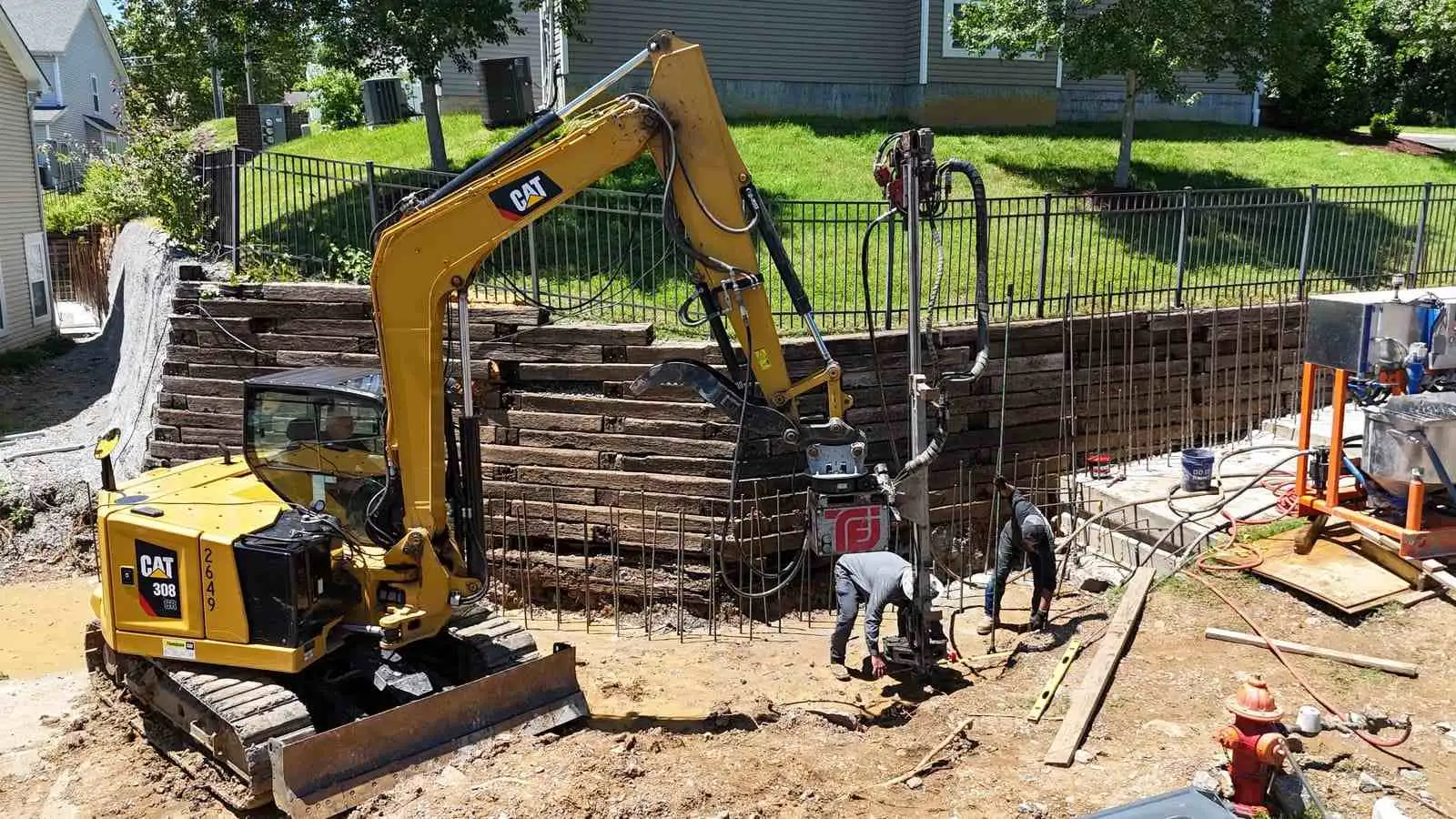
Failing Retaining Walls, Lateral Soil Pressure That Does Not Wait
Commercial retaining wall failure in Middle Tennessee caused by clay expansion, hydrostatic pressure, and inadequate drainage. Stabilize before the wall fails completely.
Not sure which fix applies to your situation? Browse our full range of solutions for commercial.
[ 01 ] Watch For These Signs
Signs that indicate foundation movement
Horizontal cracks running along the wall face
Horizontal cracking at mid-height of a retaining wall is one of the most serious warning signs. It indicates the wall is bending under lateral soil load.
Visible outward lean or bulge
Any visible lean or bulge in a commercial retaining wall is a sign of active movement.
Water weeping through wall face
Water coming through a retaining wall face means the drainage layer behind the wall has failed or was never adequate.
Settlement or cracking in pavement near wall base
Pavement cracking or settlement at the toe of a retaining wall can indicate wall sliding or rotation at the footing level.
Retaining walls are designed to handle soil pressure, but not hydrostatic water pressure. When drainage gravel behind the wall becomes clogged or was never properly installed, rainwater saturates the retained soil, dramatically increasing the lateral pressure on the wall.
Middle Tennessee red clay expands significantly when it absorbs water during wet springs and after heavy rainfall. Repeated wet and dry cycles progressively move the wall outward.
Commercial properties frequently add load near retaining walls after construction: parking areas, equipment pads, stored materials, and construction activity.
Older commercial retaining walls built with tieback anchors or deadman anchors may have systems that have corroded, slipped, or exceeded their service life.
[ 03 ] Recommended Solutions
How Ground Up fixes this
[ 04 ] Regional Context
Why foundations fail in Kentucky, Georgia, Alabama, Indiana, and Tennessee.
Expansive clay soils across Kentucky, Georgia, Alabama, Indiana, and Tennessee shrink in dry summers and swell after rain, cycling significantly in volume. Commercial and multi-family buildings built on this clay face ongoing movement pressure. Ground Up diagnoses and permanently stabilizes foundations across the region.
A retaining wall that is leaning is still standing, but it is telling you something. The question is whether you act on that information while repair is still the option, or wait until replacement is the only one left.
[ 05 ] Why Ground Up
The difference is in the diagnosis
Get several quotes and you'll see a wide range of prices. The gap isn't luck. It's whether the contractor finds the actual cause and stands behind the work.
- In-house certified crews: we never subcontract your repair
- Optional independent third-party engineer review on larger jobs
- Honest three-tier triage: we tell you what can wait, in writing
- Family owned from the same Shelbyville Highway address since 2009
[ 06 ] FAQ
Failing Retaining Walls questions
Whether a wall can be repaired or must be replaced depends on how far it has deflected, whether the structural integrity of the wall material itself is compromised, and whether the foundation conditions can support a tieback repair.
Any commercial retaining wall that is actively moving or showing horizontal cracking should be assessed without delay. A wall that fails suddenly can cause significant property damage and create serious liability exposure.
More Problem Signs
Other signs to watch for
Cart Path Slab Settlement
Golf course cart path settlement creates two problems that course operators deal with every season: safety liability and player experience. A cart path with stepped joints or lifted slab edges creates a bump hazard for cart traffic. In Middle Tennessee, where wet springs and dry summers cycle through reliably every year, cart path settlement is a predictable maintenance issue on courses built on the region's expansive clay soils.
Commercial Slab Settlement
Commercial slab settlement occurs when the soil beneath a concrete slab loses its bearing capacity, causing sections of the slab to drop below their original elevation. In Middle Tennessee commercial buildings, this shows up as uneven warehouse floors that create forklift hazards, settled loading dock aprons that gap at the building wall, and cracked retail and office floors visible through flooring.
Grain Bin Foundation Failure
Grain bin foundation failure in Middle Tennessee most commonly presents as settlement of the concrete ring or pad beneath the bin, separation between the bin ring and the foundation, and tilting of the bin structure. A grain bin foundation that has settled unevenly changes the bin's structural load distribution and creates gaps where moisture and pests can enter storage.
Multi-Unit Foundation Movement
Foundation movement in a multi-family building shows up differently than in a single-family home because the building type distributes the signs across more units and more surfaces. A corner apartment with sticking doors, diagonal cracks at window corners, and gaps forming at the baseboard may be experiencing differential settlement at that building corner while other units remain unaffected.
Solar Array Ground Issues
Solar array ground mount systems in Middle Tennessee depend on the pier foundations beneath them to hold position through decades of wind load, panel weight, and seasonal soil movement. When ground mount foundations are inadequate, the first signs appear as panel tilt, row misalignment, or visible movement in the racking structure.
Seeing these signs in your home?
We'll find the cause and give you a straight, written scope.