
Commercial Helical Pier Installation in Middle Tennessee
Engineered, torque-logged helical pier systems for commercial foundations, multi-family buildings, and large-scale pier projects across Rutherford, Davidson, and Williamson counties.
On cost: Commercial helical pier pricing depends on shaft diameter, total pier count, depth to bearing, and site access. Contact us for a project-specific estimate.
Overview
Commercial Helical Piers
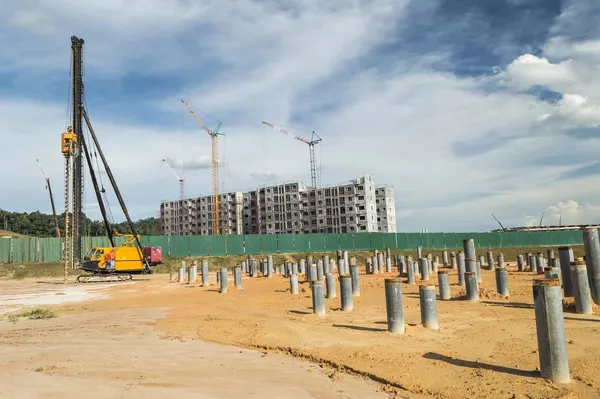
Commercial helical piers are engineered steel shaft and plate systems that transfer structural load from weak surface soils to competent load-bearing material at depth. Unlike concrete foundations that require excavation and cure time, helical piers are installed with minimal site disturbance, provide immediate load capacity verified by torque correlation, and can be installed in virtually any weather conditions.
A hydraulic rotary head drives a helical shaft with one or more helix plates into the ground at each pier location. Torque is monitored continuously throughout the drive. When the torque reading reaches the target value specified by the structural engineer, bearing capacity has been confirmed in the actual soil at that depth. A structural bracket is attached to the shaft and connected to the foundation or footing.
Wondering if this is the right fix for what you are seeing? Learn more about the warning signs: Commercial Slab Settlement and Multi-Unit Foundation Movement and Solar Array Ground Issues . Or browse the full Problem Signs library for commercial.
Installation Process
How we install commercial helical piers
Geotechnical Review
We review the site's geotech report and the structural engineer's pier specifications before mobilizing.
Site Mobilization
Crews arrive with equipment sized for the shaft diameter, depth, and site access conditions.
Pier Drive with Torque Monitoring
Each pier is driven to the torque target specified for the project load case. Torque is recorded continuously.
Bracket Installation
A structural bracket is attached to the pier shaft and connected to the existing foundation or footing.
Documentation
Torque logs, pier locations, shaft diameters, and installation depths are recorded for every pier. As-built documentation is delivered with the final invoice.
On commercial sites, torque documentation is not optional. It is the only way to confirm that every pier reached bearing capacity in the actual soil at that location rather than a depth estimate on a drawing.
Why Ground Up
The difference is in the diagnosis
Get several quotes and you'll see a wide range of prices. The gap isn't luck. It's whether the contractor finds the actual cause and stands behind the work.
- In-house certified crews: we never subcontract your repair
- Optional independent third-party engineer review on larger jobs
- Honest three-tier triage: we tell you what can wait, in writing
- Family owned from the same Shelbyville Highway address since 2009
FAQ
Commercial Helical Piers questions
We install 2-7/8 inch, 3-1/2 inch, and 4-1/2 inch round shaft helical piers. Shaft size and helix plate configuration are specified by the structural engineer based on the project load case and geotech report.
We provide torque log data for every pier, as-built pier locations and depths, shaft diameter and helix configuration records, and a final installation summary. Material product data sheets are included for the pier system.
Empirical correlation between installation torque and helical pier capacity has been established by the helical pier industry and is recognized in ICC-ES evaluation reports for pier products.
More Solutions
Other solutions we offer
Commercial Carbon Fiber Wall Reinforcement
Commercial carbon fiber wall reinforcement applies high-tensile-strength carbon fiber straps bonded to the interior face of a bowing or deflecting wall, creating a rigid stabilization system that transfers lateral load to the floor slab and structural framing above. No yard excavation is required, and installation can be completed around active building operations.
Commercial Slab Lifting and Leveling
Commercial slab lifting restores settled concrete to its original elevation by injecting expanding material beneath the slab through small-diameter access holes. No demolition, no removal of the existing concrete, no extended facility downtime. Ground Up Foundation Repair uses high-density polyurethane foam for most commercial slab lifting applications, because it expands quickly to fill voids and lift slabs, adds minimal weight to the subbase, and cures within minutes.
Commercial Polyurethane Foam Injection
Commercial polyurethane foam injection is the preferred method for lifting settled commercial concrete, filling voids beneath slabs, and stabilizing weak near-surface soils when speed, minimal disruption, and return-to-service time are priorities. The two-component foam expands on injection to fill voids and generate controlled lifting force beneath concrete. It cures to a rigid, load-bearing solid within minutes.
Pre-Construction Pier Systems
Pre-construction pier systems install engineered helical pier foundations beneath new construction footings before concrete is poured. By anchoring the foundation to competent load-bearing soil or bedrock at depth, pre-construction piers eliminate the settlement risk that standard shallow footings face in Middle Tennessee's variable clay and limestone terrain.
Agricultural Soil Stabilization
Agricultural soil stabilization addresses the weak or compressible subsoil conditions that cause foundation settlement beneath grain bins, farm buildings, and rural structures in Middle Tennessee. Rather than excavating and replacing poor subsoil, stabilization injects or introduces binding material into the soil in place, improving its load-bearing capacity and reducing its susceptibility to moisture-driven settlement.
Found a problem? Get a straight answer
Site assessment, written scope, honest triage. No pressure.