
Retaining Wall Repair, Stop Soil Movement Before It Reaches Your Foundation
[ 01 ] The Honest Answer
What you should know about retaining wall repair
Why Retaining Walls Fail in Middle Tennessee
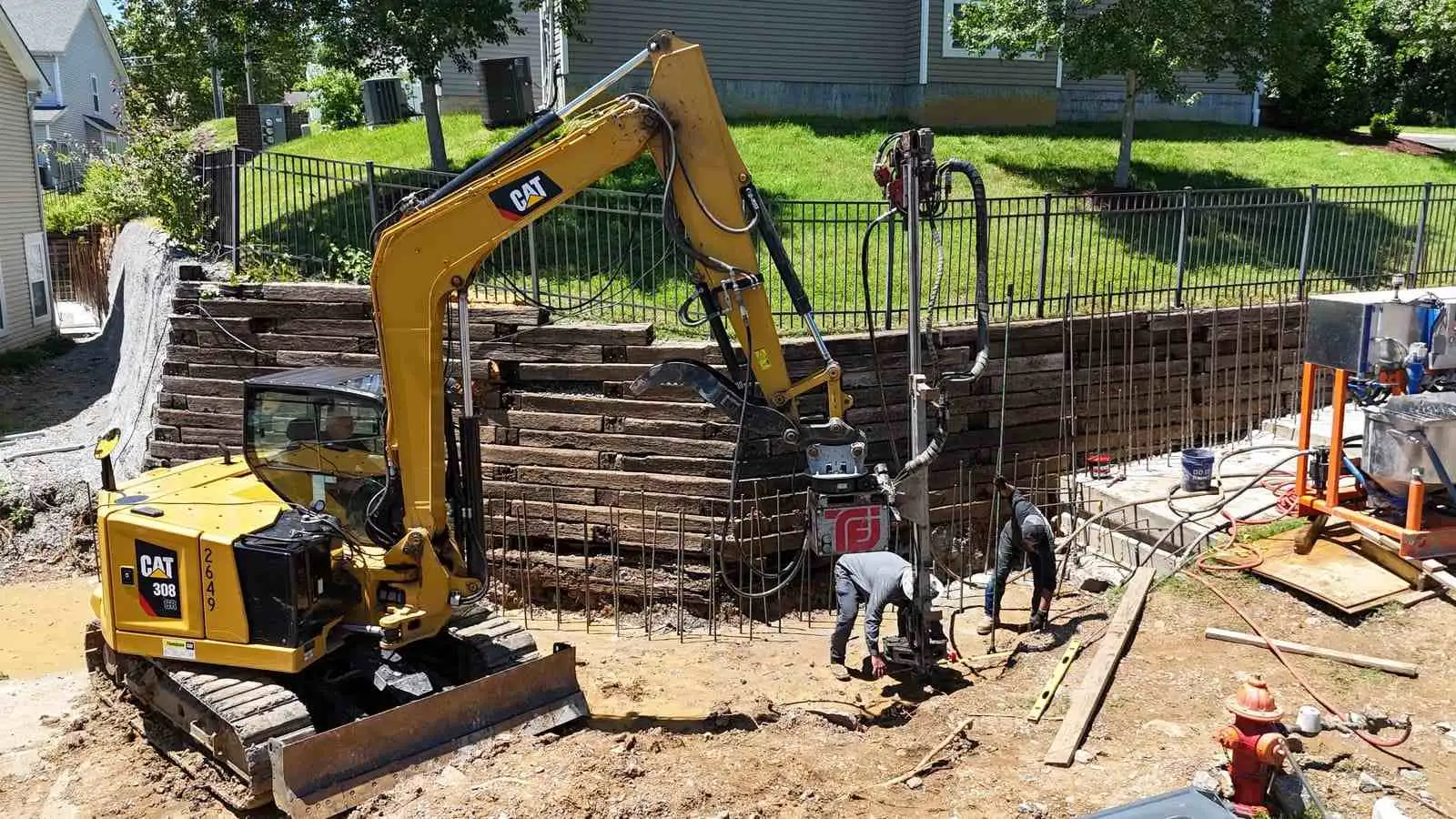
Middle Tennessee's topography, rolling hills in Williamson County, flood-prone low areas in Davidson County, and the clay-heavy soils throughout Rutherford County, creates ideal conditions for retaining wall stress. A retaining wall is always fighting hydrostatic pressure, the outward push created as water builds up in the soil behind it, along with lateral pressure from the weight of that soil, and the freeze-thaw cycle that worsens over winter. Over time, even well-built walls begin to tilt, crack, or pull away from their footings.
Early warning signs include visible outward lean, horizontal or stair-step cracks through the wall face, soil spilling from behind the wall, and separation at the wall corners. The earlier these are addressed, the more options you have.
Repair Methods We Use
- Tieback anchors: steel rods driven horizontally through the wall and anchored in undisturbed soil behind it, stabilizing the wall against further outward movement
- Drainage correction: adding or clearing drainage to relieve the hydrostatic pressure driving the failure
- Helical piers at the footing: when the wall footing itself has settled, piers can stabilize it at depth
- Partial or full rebuild: when a wall has leaned beyond the point of economic repair, we rebuild it with proper drainage design to prevent recurrence
Not every leaning retaining wall needs to be torn down and rebuilt. Call us at (615) 624-1027 for a free inspection and we will tell you exactly what the wall needs.
[ 02 ] How It Works
What to expect, start to finish
Free Inspection
We assess wall lean, crack patterns, drainage conditions, and footing stability to determine the right repair approach.
Drainage Evaluation
We check what is behind the wall and determine whether hydrostatic pressure is driving the failure.
Repair Plan
We recommend tieback anchors, drainage correction, footing stabilization, or rebuild depending on the extent of failure.
Stabilization Work
Anchors are installed, drainage is corrected, and any footing work is completed.
Site Restoration
Disturbed soil and landscaping around the wall is restored. We walk the finished work with you.
A retaining wall failure is a drainage problem as often as it is a structural one. We always check the drain system behind the wall before recommending a repair method, fixing the pressure source is as important as fixing the wall.
[ 03 ] Why Ground Up
The difference is in the diagnosis
Get several quotes and you'll see a wide range of prices. The gap isn't luck. It's whether the contractor finds the actual cause and stands behind the work.
- In-house certified crews: we never subcontract your repair
- Optional independent third-party engineer review on larger jobs
- Honest three-tier triage: we tell you what can wait, in writing
- Family owned from the same Shelbyville Highway address since 2009
Retaining Wall Repair questions

Free guide
Get the free foundation settlement guide
- A room by room checklist of warning signs
- How Middle Tennessee red clay can move a house
- What happens at a free inspection
Your guide is on its way.
Check your inbox for an email from Ground Up Foundation Repair. If it is not there in a few minutes, check your spam or promotions folder.
Where we work
Headquartered in Murfreesboro,
serving Middle Tennessee
From red-clay Rutherford County soil to Nashville’s high water tables and Cookeville’s karst limestone, we know the ground beneath your home.
Also serving: La Vergne, Hendersonville, Gallatin, Lebanon, Clarksville, Tullahoma, Nolensville, Antioch + 100 more cities →
Found a problem? Get a straight answer
Free inspection, written estimate, honest triage. No pressure.