
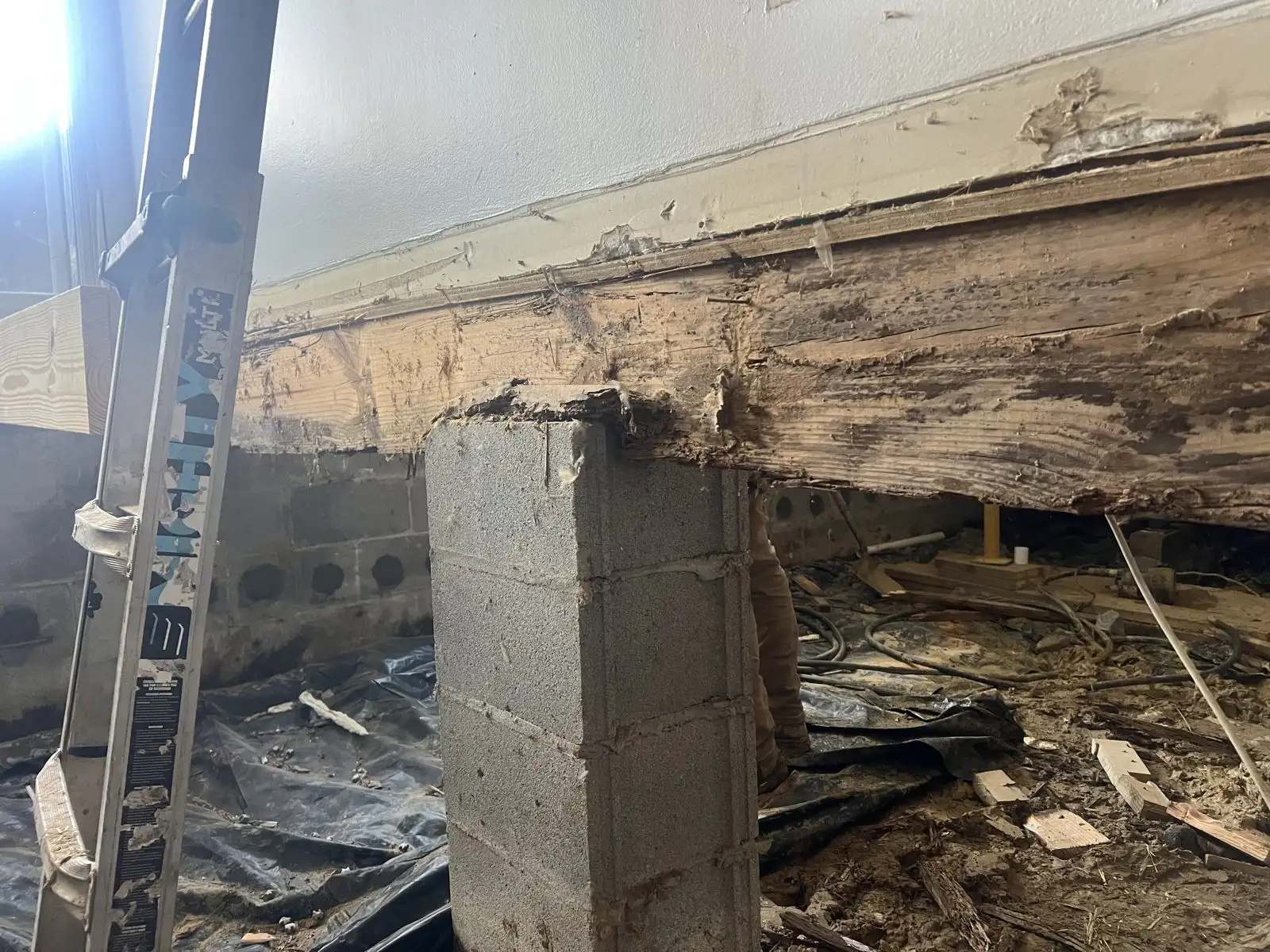
Sagging Floor Joists Mean Your Home's Structural Frame Is Losing the Fight Against Gravity
Ground Up Foundation Repair provides free crawl space inspections throughout Nashville and Middle Tennessee.
For the whole repair, from joists to beams and posts, see how we fix a sagging floor. Not sure which fix applies to your situation? Browse our full range of solutions for framing repair.
[ 01 ] Watch For These Signs
Early Signs of Sagging Floor Joists
Springy or Bouncy Floors
Floors that flex noticeably when you walk across them, more than they used to, indicate joists that have lost stiffness and are deflecting under live load.
Visible Floor Slope
A marble or ball placed on the floor rolling consistently toward one low point, or a visible dip visible when sighting down a hardwood floor from a low angle, indicates significant joist deflection.
Cracked Tile Grout Lines
Tile grout lines that crack in a linear pattern across the floor surface indicate the subfloor beneath is deflecting, a reliable early indicator of joist problems before the deflection becomes visible to the naked eye.
Baseboard Gaps
Baseboards that gap from the floor on one end of a wall, or that are wider at the top or bottom, indicate the floor surface has moved relative to the wall, a sign of framing deflection below.
Wood gains rigidity from its cellular structure. When chronic crawl space moisture causes early-stage decay or simply saturates the wood fibers, the joist loses a significant portion of its stiffness, it can still carry load without breaking, but it deflects excessively under normal household weights. Middle Tennessee's clay soils and seasonal rainfall make crawl space humidity control a persistent challenge.
Longer spans require intermediate supports, typically a carrier beam with posts bearing on footings. When crawl space posts settle, lean, or rot at their base, the carrier beam drops, and the joists it was supporting sag with it. A dropped beam often affects an entire section of floor rather than individual joists.
Older Middle Tennessee homes were sometimes built with joists that were undersized for the span or spaced further apart than current standards recommend. These systems may have performed adequately when the home was built but deflect more as the wood ages, and become more pronounced as household loads change over time.
Adding heavy items, a filled bathtub over a previously unloaded span, heavy appliances, or a concentrated load in a specific floor area, can cause joist deflection that was not present before. The floor may have been performing acceptably under original loads but sags under the new demand.
[ 03 ] Recommended Solutions
How Ground Up fixes this
[ 04 ] Regional Context
Why Middle Tennessee foundations fail
Middle Tennessee's expansive clay soils shrink in dry summers and swell after rain, cycling significantly in volume. Davidson, Williamson, and Rutherford County homes built on this clay face ongoing movement pressure. Ground Up diagnoses and permanently stabilizes foundations across the region.
Sagging floors do not fix themselves. Once a joist has deflected under load, the wood fibers are under sustained stress. If there is any moisture or decay involved, that stress accelerates the deterioration. The sooner we can get under the home and look at it, the more options we have for a less invasive repair.
[ 05 ] Why Ground Up
The difference is in the diagnosis
Get several quotes and you'll see a wide range of prices. The gap isn't luck. It's whether the contractor finds the actual cause and stands behind the work.
- In-house certified crews: we never subcontract your repair
- Optional independent third-party engineer review on larger jobs
- Honest three-tier triage: we tell you what can wait, in writing
- Family owned from the same Shelbyville Highway address since 2009
[ 06 ] FAQ
Sagging Floor Joists questions
Building codes typically allow deflection of span divided by 360 under live load for stiffness-sensitive finishes. In practical terms, a floor that noticeably bounces under footsteps or has a visible slope has likely exceeded acceptable deflection limits. Our inspection will measure actual deflection and compare it to applicable standards.
In most cases, yes. Sistering a new joist alongside the sagging one and raising it to level restores structural performance without disturbing the finished floor surface above. Some minor cosmetic repairs may be needed at trim lines, but the floor surface itself is typically not affected by the repair.
It depends on the repair method. Sistering restores structural capacity but does not mechanically push the old joist back up. If floor leveling is a specific goal, we use adjustable steel columns or other support methods that can lift the framing to a more level position. We discuss both options during the inspection.
Joists span between beams and carry floor loads directly. Beams carry multiple joists and transfer their combined load to posts or foundation walls. A sagging beam drops an entire section of floor, while a sagging joist typically affects a narrower area. Both require repair, but the approaches differ, our inspection identifies exactly what is sagging and why.
Yes. Repairing joists without addressing the moisture source is a temporary solution. New wood installed in a wet crawl space will begin the same deterioration cycle. We typically address the moisture problem as part of the overall repair plan.
More Problem Signs
Other signs to watch for
Broken or Cracked Floor Joists in the Crawl Space
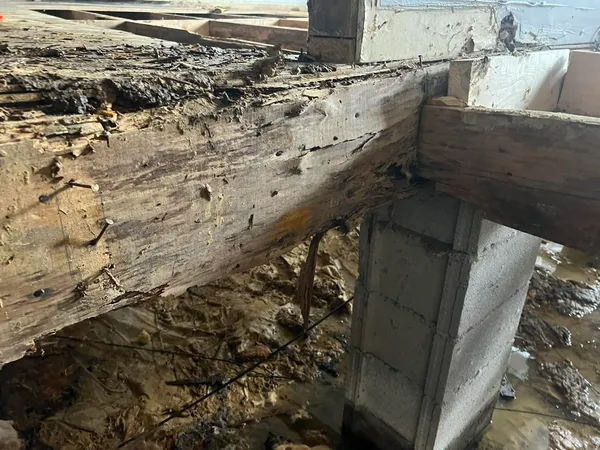
Floor joists are the horizontal framing members that span between the foundation walls or beams and support the subfloor, and everything above it. Broken or cracked joists occur when a single joist or multiple joists fail due to overloading, moisture-induced decay, insect damage, or improper notching and boring during past repairs. The result is a floor system that flexes, sags, or bounces in the affected area, and a structural problem that grows worse with continued loading.
Mold on Crawl Space Framing
Mold on crawl space framing is frequently discussed as a health issue, and it absolutely is one. But in the context of structural framing, mold is also one of the earliest and most reliable indicators that moisture conditions are severe enough to eventually cause wood rot. The same high humidity that allows mold to colonize the surface of floor joists and beams will, over time, allow rot fungi to penetrate and degrade the structural core of the wood. Catching and correcting mold on framing early is an opportunity to prevent the costlier structural repairs that follow if conditions persist.
Pest Damage to Wood Framing
Pest damage to crawl space framing is uniquely dangerous because it is almost entirely concealed during its active phase. Termites, carpenter ants, and wood-boring beetles do their damage inside dimensional lumber, hollowing out the structural core while the exterior surface may appear intact. By the time floors begin to feel soft, sag, or creak noticeably, the framing has typically already lost a significant percentage of its load-bearing cross-section. In Middle Tennessee, where subterranean termites are endemic and damp crawl spaces provide ideal nesting conditions, pest damage is a leading contributor to framing failure.
Rotted Deck Joists
Deck joists are exposed to weather in a way that interior floor joists are not. Rain, snow melt, condensation, and seasonal moisture cycling make deck framing the part of any home most vulnerable to rot. In Middle Tennessee's humid subtropical climate, untreated deck wood can begin to show meaningful rot within a few years if the deck design does not allow for adequate drainage and drying. Rotted deck joists are particularly dangerous because the damage is often invisible from above, the decking boards look fine while the structure beneath them has lost significant load capacity.
Rotted Floor Joists
Wood rot is caused by fungi that consume the cellulose and lignin that give wood its strength. Once rot establishes in a floor joist, it is not reversible, the destroyed wood fibers cannot regenerate. A joist in early-stage rot loses stiffness; in advanced rot, it loses load capacity. Middle Tennessee crawl spaces are particularly prone to wood rot because of the region's high annual rainfall, clay soils that hold moisture, and seasonal temperature swings that drive condensation on framing members. Without moisture control, rot in one joist spreads to adjacent framing, sill plates, and subfloor sheathing.
Soft or Weak Floors
Soft, spongy, bouncy, or visibly sagging floors are a clear signal that the structural framing beneath your home is compromised. Floor joists and support beams in crawl spaces are particularly vulnerable in Middle Tennessee, where high annual rainfall, clay soils, and humid summers create persistently damp conditions. When wood framing absorbs moisture over months or years, it softens, loses load-bearing capacity, and eventually rots, leaving your floors with no solid support.
Seeing these signs in your home?
We'll find the cause and tell you honestly what it needs, free.