
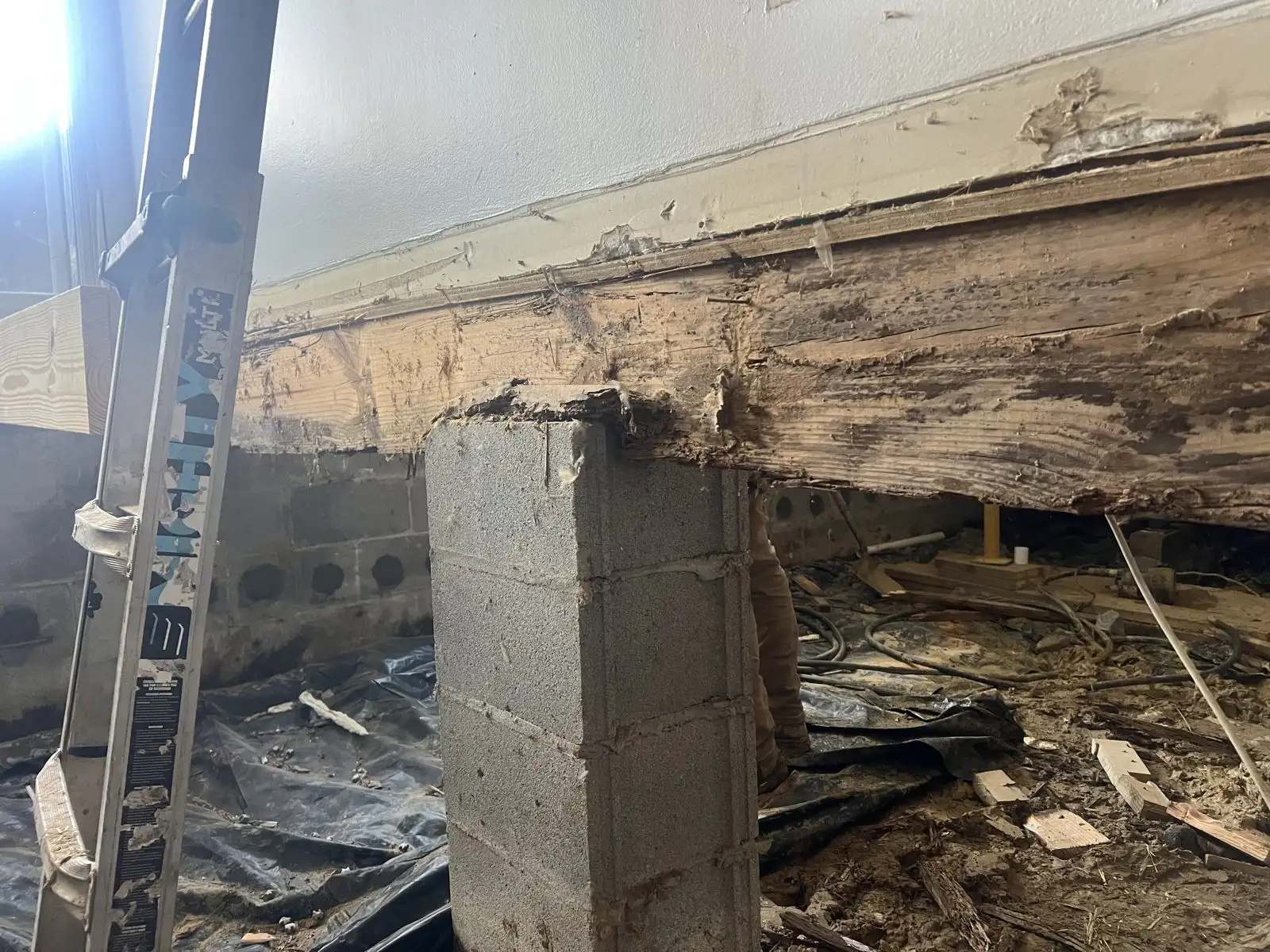
Rotted Deck Joists Are a Hidden Safety Hazard That Worsens Every Season
Ground Up Foundation Repair inspects and repairs deck framing throughout Nashville and Middle Tennessee. Free estimate.
Not sure which fix applies to your situation? Browse our full range of solutions for framing repair.
[ 01 ] Watch For These Signs
Early Signs of Rotted Deck Joists
Soft or Springy Deck Boards
Decking boards that feel soft or springy when walked on, particularly at the ends or along specific joist lines, indicate joist deterioration directly beneath the affected surface area.
Visible Darkening Between Boards
Visible darkening, staining, or discoloration on the tops of joists visible between deck boards indicates moisture accumulation and possible early fungal growth on the framing.
Boards Separating or Cupping
Deck boards that have started to separate, cup, or pull away from fasteners indicate movement and moisture activity in the framing below, as the structure shifts under differential moisture exposure.
Ledger Board Rot or Staining
Visible rot or soft wood at the ledger board where the deck meets the house is a sign of failed flashing, one of the most structurally significant rot locations, as it can spread into the home's rim joist and floor framing.
Debris, leaves, and organic material that collect on deck surfaces hold moisture against the top of the joists. Where decking boards sit directly on joists, moisture is trapped at the interface and cannot dry. Middle Tennessee's warm, humid summers accelerate fungal growth at these contact points.
Wood absorbs moisture far more rapidly through end grain than through face or edge grain. Deck joists that are cut to length and not end-sealed, or that have exposed ends at the ledger board or outside header, absorb moisture rapidly and develop rot from the ends inward.
Where a deck attaches to the house, the ledger board connection must be properly flashed to prevent water from running behind it and into the rim joist. Failed or absent flashing allows water to accumulate at the ledger connection, one of the most common rot locations in Middle Tennessee decks.
Joists that are spaced too close together or decking installed with no gaps trap water on the deck surface rather than allowing it to run off. Pooling water at low spots concentrates moisture directly over the framing below.
Older Middle Tennessee decks were sometimes built with lumber not rated for ground-contact or exterior use. Without the preservative treatment appropriate for the exposure class, this material deteriorates significantly faster than code-compliant treated lumber.
[ 03 ] Recommended Solutions
How Ground Up fixes this
[ 04 ] Regional Context
Why Middle Tennessee foundations fail
Middle Tennessee's expansive clay soils shrink in dry summers and swell after rain, cycling significantly in volume. Davidson, Williamson, and Rutherford County homes built on this clay face ongoing movement pressure. Ground Up diagnoses and permanently stabilizes foundations across the region.
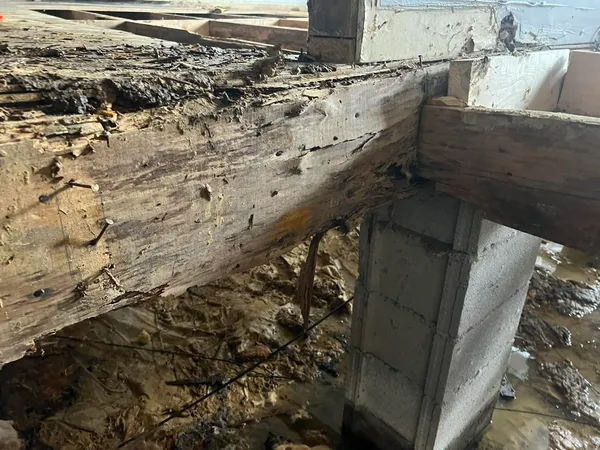
People trust their decks to hold family gatherings and all kinds of live load. The problem is that the rot doing the damage is underneath the decking where you cannot see it. A deck that looks fine from above can have joists that are 40 to 50 percent consumed. We get under every deck we inspect and probe the framing directly.
[ 05 ] Why Ground Up
The difference is in the diagnosis
Get several quotes and you'll see a wide range of prices. The gap isn't luck. It's whether the contractor finds the actual cause and stands behind the work.
- In-house certified crews: we never subcontract your repair
- Optional independent third-party engineer review on larger jobs
- Honest three-tier triage: we tell you what can wait, in writing
- Family owned from the same Shelbyville Highway address since 2009
[ 06 ] FAQ
Rotted Deck Joists questions
The most reliable indicator is probing the wood directly, a screwdriver or awl will penetrate rotted wood with minimal force. From above, soft or springy spots when walking the deck are the most common sign. Dark staining between deck boards, loose fasteners, and boards that have cupped or separated can also indicate compromised framing below.
Replacing a single, easily accessible joist is technically within the reach of a capable DIYer. However, rot assessment requires knowing how to identify all affected framing, not just the obviously failed member. Missing adjacent rot or failing to address the moisture source results in the same problem recurring. We recommend a professional assessment even if the homeowner handles some of the repair.
Structural repairs to an existing deck often require a permit in Tennessee jurisdictions. Requirements vary by county and municipality. We recommend checking with your local building department. Ground Up can advise on what is typically required based on the scope of repair.
Sistering is a viable approach when the existing joist has failed in a localized section and the remainder is structurally sound. The sister must be the same species and grade as the original, properly treated for exterior use, and fastened with corrosion-resistant hardware. We evaluate each joist individually during inspection.
That depends on the extent of rot, the age of the decking and hardware, and the design of the original structure. If rot is confined to a few joists and the ledger board, decking, and posts are sound, targeted joist repair is the right move. If the deck is older, the ledger flashing has failed, and multiple members are compromised, a full deck replacement is often the more practical scope of work. We provide an honest assessment of both options.
More Problem Signs
Other signs to watch for
Broken or Cracked Floor Joists in the Crawl Space
Floor joists are the horizontal framing members that span between the foundation walls or beams and support the subfloor, and everything above it. Broken or cracked joists occur when a single joist or multiple joists fail due to overloading, moisture-induced decay, insect damage, or improper notching and boring during past repairs. The result is a floor system that flexes, sags, or bounces in the affected area, and a structural problem that grows worse with continued loading.
Mold on Crawl Space Framing
Mold on crawl space framing is frequently discussed as a health issue, and it absolutely is one. But in the context of structural framing, mold is also one of the earliest and most reliable indicators that moisture conditions are severe enough to eventually cause wood rot. The same high humidity that allows mold to colonize the surface of floor joists and beams will, over time, allow rot fungi to penetrate and degrade the structural core of the wood. Catching and correcting mold on framing early is an opportunity to prevent the costlier structural repairs that follow if conditions persist.
Pest Damage to Wood Framing
Pest damage to crawl space framing is uniquely dangerous because it is almost entirely concealed during its active phase. Termites, carpenter ants, and wood-boring beetles do their damage inside dimensional lumber, hollowing out the structural core while the exterior surface may appear intact. By the time floors begin to feel soft, sag, or creak noticeably, the framing has typically already lost a significant percentage of its load-bearing cross-section. In Middle Tennessee, where subterranean termites are endemic and damp crawl spaces provide ideal nesting conditions, pest damage is a leading contributor to framing failure.
Rotted Floor Joists
Wood rot is caused by fungi that consume the cellulose and lignin that give wood its strength. Once rot establishes in a floor joist, it is not reversible, the destroyed wood fibers cannot regenerate. A joist in early-stage rot loses stiffness; in advanced rot, it loses load capacity. Middle Tennessee crawl spaces are particularly prone to wood rot because of the region's high annual rainfall, clay soils that hold moisture, and seasonal temperature swings that drive condensation on framing members. Without moisture control, rot in one joist spreads to adjacent framing, sill plates, and subfloor sheathing.
Sagging Floor Joists
Floor joists are designed to span horizontally between supports and resist the vertical loads placed on them. When a joist sags, it has deflected beyond acceptable limits, meaning the wood is bending more than it should under normal household loads. Sagging joists produce floors that feel bouncy or soft, tile finishes that crack, and in serious cases, floors that visibly slope toward a low point. In Middle Tennessee crawl space homes, joist sagging is driven by moisture deterioration, inadequate mid-span support, or original framing that was undersized for the span.
Soft or Weak Floors
Soft, spongy, bouncy, or visibly sagging floors are a clear signal that the structural framing beneath your home is compromised. Floor joists and support beams in crawl spaces are particularly vulnerable in Middle Tennessee, where high annual rainfall, clay soils, and humid summers create persistently damp conditions. When wood framing absorbs moisture over months or years, it softens, loses load-bearing capacity, and eventually rots, leaving your floors with no solid support.
Seeing these signs in your home?
We'll find the cause and tell you honestly what it needs, free.