
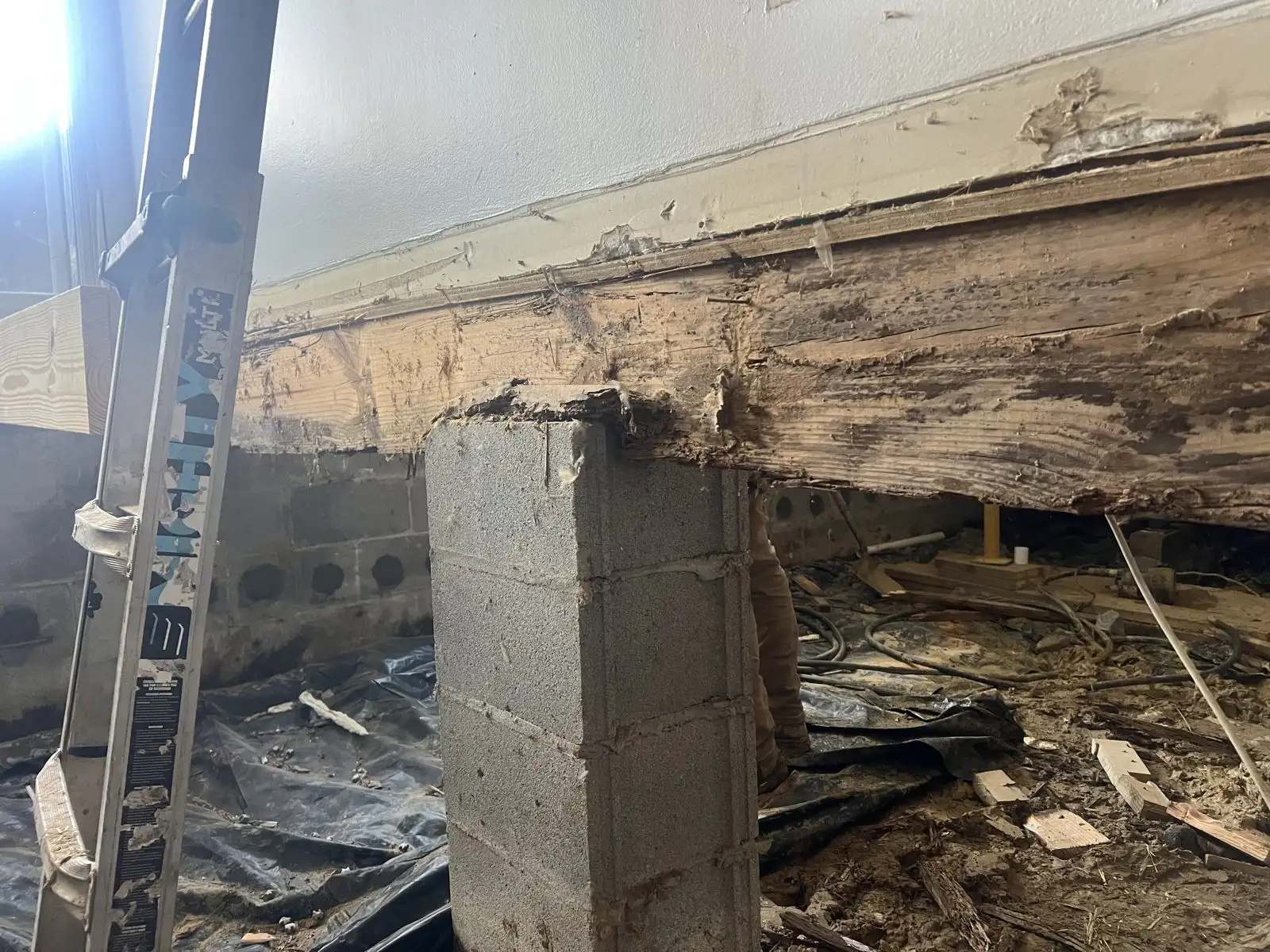
Rotted or Failed Crawl Space Beams Need More Than a Patch
[ 01 ] The Honest Answer
What you should know about crawl space beam replacement
What Are Crawl Space Beams and Why Do They Fail?
Crawl space beams, also called girder beams or main beams, are the primary horizontal structural members that span between foundation piers or walls and carry the load of the floor joists above. Every joist in your floor system rests on a beam, and every beam transfers that load down to a post or pier. When a beam fails, the entire section of floor it carries is compromised.
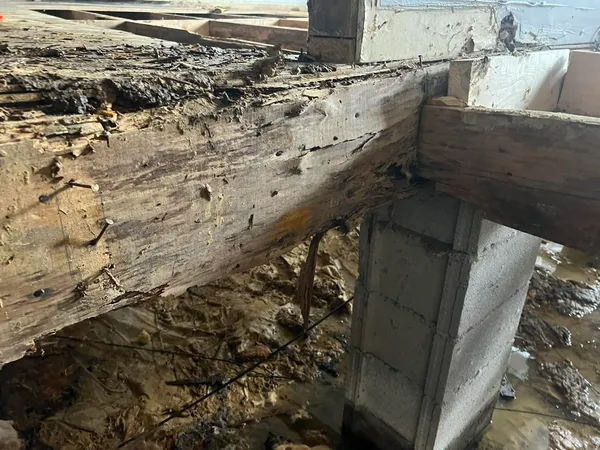
In Middle Tennessee crawl spaces, beams fail for the same reason joists fail: moisture. Nashville's high annual rainfall, humid summers, and clay soils that retain groundwater create conditions where untreated lumber absorbs moisture continuously over years and decades. Fungal decay sets in and progressively degrades the wood fibers that give the beam its structural capacity. What begins as surface mold eventually reaches the core of the member, and a beam that once carried tens of thousands of pounds of load becomes soft, spongy, and structurally unreliable.
Sistering vs. Full Beam Replacement
Sistering, adding a new member alongside an existing one, works well for joists and can work for beams under the right conditions. But beams are often larger, heavier, and more deeply embedded in the crawl space structure than joists. When rot has penetrated through the full cross-section of a beam, or when the beam has cracked through along its length, sistering cannot restore the required structural capacity. Full replacement is the correct repair.
- Replace when: rot penetrates the full cross-section, the beam has cracked or split through, or mid-span deflection is severe enough that the floor system cannot be leveled without removing the beam
- Sister when: rot is localized to one face or end of the beam, the core is still sound, and the existing beam can provide composite action with a new member alongside it
Our Beam Replacement Process
Beam replacement in a crawl space requires temporary support shoring to carry the floor load during the work. We install temporary supports beneath the affected floor section before removing the failed beam, ensuring the structure above remains stable throughout the process. The replacement beam is sized to match or exceed the original specification, cut to fit, and installed on the same bearing points as the removed beam. Where original bearing points have deteriorated, we repair or rebuild them as part of the same engagement.
We use pressure-treated lumber for all crawl space beam installations to provide long-term resistance to moisture and fungal decay. In some situations, a steel beam or engineered lumber product may be appropriate, we will discuss material options with you when we present the repair plan.
If moisture caused the original beam failure, we address the crawl space moisture environment as part of the repair. Vapor barrier installation, drainage, and dehumidification work together with structural repair to protect the new beam long-term. Call us at (615) 624-1027 for a free crawl space beam inspection.
[ 02 ] How It Works
What to expect, start to finish
Crawl Space Beam Inspection
We assess beam condition across the full crawl space, identify sections that have failed beyond what sistering can address, and determine the extent of any bearing point or post damage.
Beam Replacement Plan
We present a specific plan covering which beams require replacement, material selection, shoring requirements, and any moisture control measures that should accompany the structural work.
Shoring, Removal, and Installation
We install temporary shoring beneath the affected floor section, remove the failed beam, prepare the bearing points, and install the replacement beam sized to carry the required load.
Final Inspection and Warranty
We remove temporary shoring, confirm the new beam is in full bearing contact, inspect the floor system response, and provide warranty documentation covering labor and installed materials.
When a beam is rotted through, sistering gives you a false sense of security. You are attaching a new member to something that cannot hold its own weight, let alone contribute to a composite section. Full replacement is the honest answer, and it is what we recommend when the inspection shows the beam is past the point of no return.
[ 03 ] Why Ground Up
The difference is in the diagnosis
Get several quotes and you'll see a wide range of prices. The gap isn't luck. It's whether the contractor finds the actual cause and stands behind the work.
- In-house certified crews: we never subcontract your repair
- Optional independent third-party engineer review on larger jobs
- Honest three-tier triage: we tell you what can wait, in writing
- Family owned from the same Shelbyville Highway address since 2009
Crawl Space Beam Replacement questions
Where we work
Headquartered in Murfreesboro,
serving Middle Tennessee
From red-clay Rutherford County soil to Nashville’s high water tables and Cookeville’s karst limestone, we know the ground beneath your home.
Also serving: La Vergne, Hendersonville, Gallatin, Lebanon, Clarksville, Tullahoma, Nolensville, Antioch + 100 more cities →
Found a problem? Get a straight answer
Free inspection, written estimate, honest triage. No pressure.