
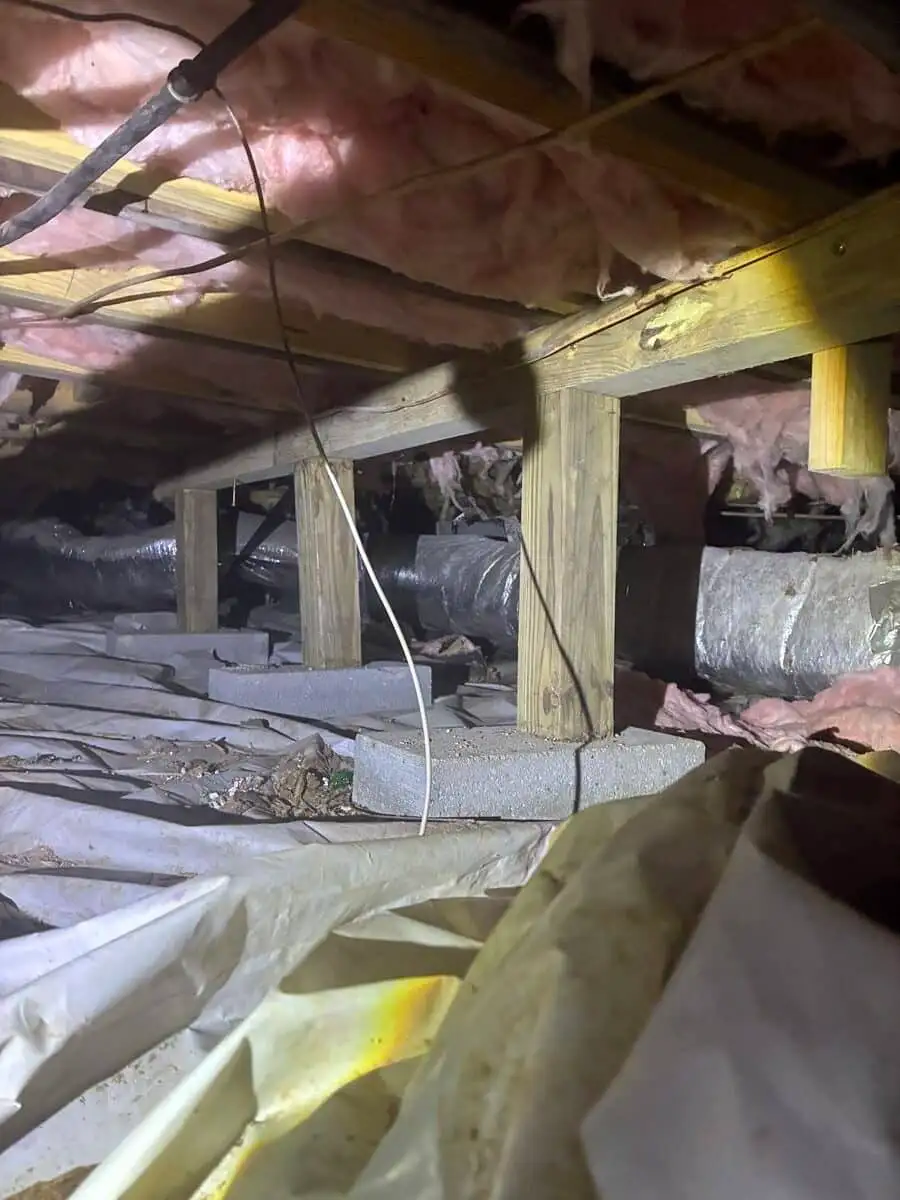
Broken or Cracked Floor Joists Put Your Home's Floor System at Risk
The floor joists in your crawl space are the structural backbone of your floors. When they crack, split, or break under load or decay, the floor above loses its support and the damage can spread.
Not sure which fix applies to your situation? Browse our full range of solutions for framing repair.
[ 01 ] Watch For These Signs
Signs that indicate foundation movement
Bouncy or spongy floor above the crawl space
A floor that moves more than normal when walked on, particularly in one area, often indicates a compromised joist or set of joists beneath it. The flex increases as the structural capacity decreases.
Visible cracking or splitting in joists when inspected
A crawl space inspection that reveals joists with lengthwise cracks, splits, or breaks confirms structural damage. Cracks at the ends of joists, near bearing points, or at the center of the span are particularly concerning.
Sagging or uneven floor surface
A floor that has developed a low spot or visible sag over the crawl space, detectable by placing a level or rolling a ball across it, indicates that one or more joists have deflected beyond their design limit, likely due to damage.
Dark staining or mushroom-like growth on joist surface
Discoloration, dark staining, or visible fungal growth on the surface of floor joists confirms moisture damage and active wood decay, both of which significantly compromise joist strength before visible cracking occurs.
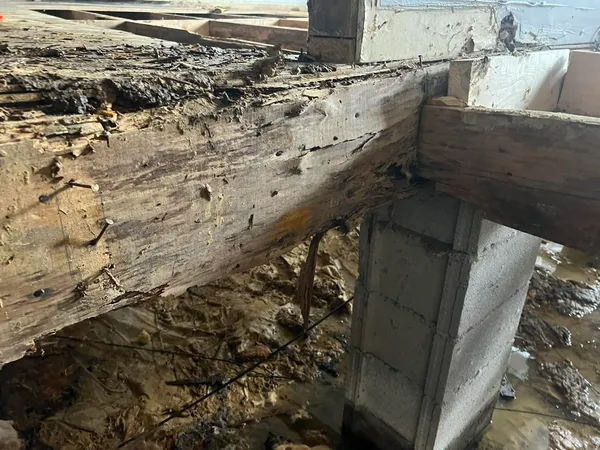
In damp or unencapsulated crawl spaces, floor joists made of lumber absorb moisture over time. Wet wood loses strength, and if conditions are persistently damp, fungal decay establishes, progressively breaking down the wood fiber until the joist cannot support load without cracking or breaking.
Termites and wood-boring beetles consume or hollow out floor joist lumber from within, leaving a shell that looks intact from the outside but has lost its load-carrying capacity. Middle Tennessee's climate is favorable to termite activity, and crawl space joists are a primary target.
Joists that are undersized for their span, or that have had heavy loads added above them, such as a hot tub, heavy furniture, or additional flooring materials, can crack under sustained load beyond their design capacity.
Plumbers, electricians, and HVAC contractors sometimes cut notches or bore holes through floor joists to route pipes, wires, or ductwork. When notches are made in the wrong location or at the wrong size, the joist is significantly weakened and may crack under normal loading.
In older homes, floor joists may be approaching or past their effective service life, particularly if the crawl space has had periods of elevated moisture. Age-related checking and splitting reduces load capacity and can progress to failure.
[ 04 ] Regional Context
Why Middle Tennessee foundations fail
Middle Tennessee's expansive clay soils shrink in dry summers and swell after rain, cycling significantly in volume. Davidson, Williamson, and Rutherford County homes built on this clay face ongoing movement pressure. Ground Up diagnoses and permanently stabilizes foundations across the region.
When a joist is cracked, the floor is telling you the structure is carrying load it was not designed to carry through that member. We fix the joist, then we find out why it failed, because if the cause stays, the next joist is next.
[ 05 ] Why Ground Up
The difference is in the diagnosis
Get several quotes and you'll see a wide range of prices. The gap isn't luck. It's whether the contractor finds the actual cause and stands behind the work.
- In-house certified crews: we never subcontract your repair
- Optional independent third-party engineer review on larger jobs
- Honest three-tier triage: we tell you what can wait, in writing
- Family owned from the same Shelbyville Highway address since 2009
[ 06 ] FAQ
Broken or Cracked Floor Joists in the Crawl Space questions
Many cracked joists can be repaired using a process called sistering, where a new full-length joist is fastened alongside the damaged one, restoring the structural capacity of the pair. Replacement is necessary when the joist is so severely decayed or damaged that sistering cannot provide adequate bearing. Our framing inspection identifies which approach is appropriate for each damaged member.
There is no universal threshold. A single cracked joist in an isolated area may be a simple repair. Multiple compromised joists across a span, or damage to the main carrying beam, is a more significant structural problem. We assess each situation by examining the extent and distribution of damage and the condition of the surrounding framing system.
Coverage depends on the cause of damage and the specific policy. Sudden damage from an insured event, such as a pipe burst that soaked the joists, may be covered. Long-term moisture damage or insect damage is typically excluded as a maintenance issue. We can document the damage thoroughly to support any claim you file with your insurer.
A single-joist sistering in an accessible crawl space typically takes one day. More extensive framing work involving multiple joists, main beam repair, or post replacement may take two to four days depending on the size of the affected area and access conditions. We provide a project timeline with every estimate.
Both should be addressed in the same project. Repairing joists without eliminating the moisture source allows the new or sistered lumber to begin deteriorating under the same conditions that damaged the original. We typically pair framing repair with crawl space encapsulation or drainage correction to ensure the repaired framing stays dry.
More Problem Signs
Other signs to watch for
Mold on Crawl Space Framing
Mold on crawl space framing is frequently discussed as a health issue, and it absolutely is one. But in the context of structural framing, mold is also one of the earliest and most reliable indicators that moisture conditions are severe enough to eventually cause wood rot. The same high humidity that allows mold to colonize the surface of floor joists and beams will, over time, allow rot fungi to penetrate and degrade the structural core of the wood. Catching and correcting mold on framing early is an opportunity to prevent the costlier structural repairs that follow if conditions persist.
Pest Damage to Wood Framing
Pest damage to crawl space framing is uniquely dangerous because it is almost entirely concealed during its active phase. Termites, carpenter ants, and wood-boring beetles do their damage inside dimensional lumber, hollowing out the structural core while the exterior surface may appear intact. By the time floors begin to feel soft, sag, or creak noticeably, the framing has typically already lost a significant percentage of its load-bearing cross-section. In Middle Tennessee, where subterranean termites are endemic and damp crawl spaces provide ideal nesting conditions, pest damage is a leading contributor to framing failure.
Rotted Deck Joists
Deck joists are exposed to weather in a way that interior floor joists are not. Rain, snow melt, condensation, and seasonal moisture cycling make deck framing the part of any home most vulnerable to rot. In Middle Tennessee's humid subtropical climate, untreated deck wood can begin to show meaningful rot within a few years if the deck design does not allow for adequate drainage and drying. Rotted deck joists are particularly dangerous because the damage is often invisible from above, the decking boards look fine while the structure beneath them has lost significant load capacity.
Rotted Floor Joists
Wood rot is caused by fungi that consume the cellulose and lignin that give wood its strength. Once rot establishes in a floor joist, it is not reversible, the destroyed wood fibers cannot regenerate. A joist in early-stage rot loses stiffness; in advanced rot, it loses load capacity. Middle Tennessee crawl spaces are particularly prone to wood rot because of the region's high annual rainfall, clay soils that hold moisture, and seasonal temperature swings that drive condensation on framing members. Without moisture control, rot in one joist spreads to adjacent framing, sill plates, and subfloor sheathing.
Sagging Floor Joists
Floor joists are designed to span horizontally between supports and resist the vertical loads placed on them. When a joist sags, it has deflected beyond acceptable limits, meaning the wood is bending more than it should under normal household loads. Sagging joists produce floors that feel bouncy or soft, tile finishes that crack, and in serious cases, floors that visibly slope toward a low point. In Middle Tennessee crawl space homes, joist sagging is driven by moisture deterioration, inadequate mid-span support, or original framing that was undersized for the span.
Soft or Weak Floors
Soft, spongy, bouncy, or visibly sagging floors are a clear signal that the structural framing beneath your home is compromised. Floor joists and support beams in crawl spaces are particularly vulnerable in Middle Tennessee, where high annual rainfall, clay soils, and humid summers create persistently damp conditions. When wood framing absorbs moisture over months or years, it softens, loses load-bearing capacity, and eventually rots, leaving your floors with no solid support.
Seeing these signs in your home?
We'll find the cause and tell you honestly what it needs, free.