
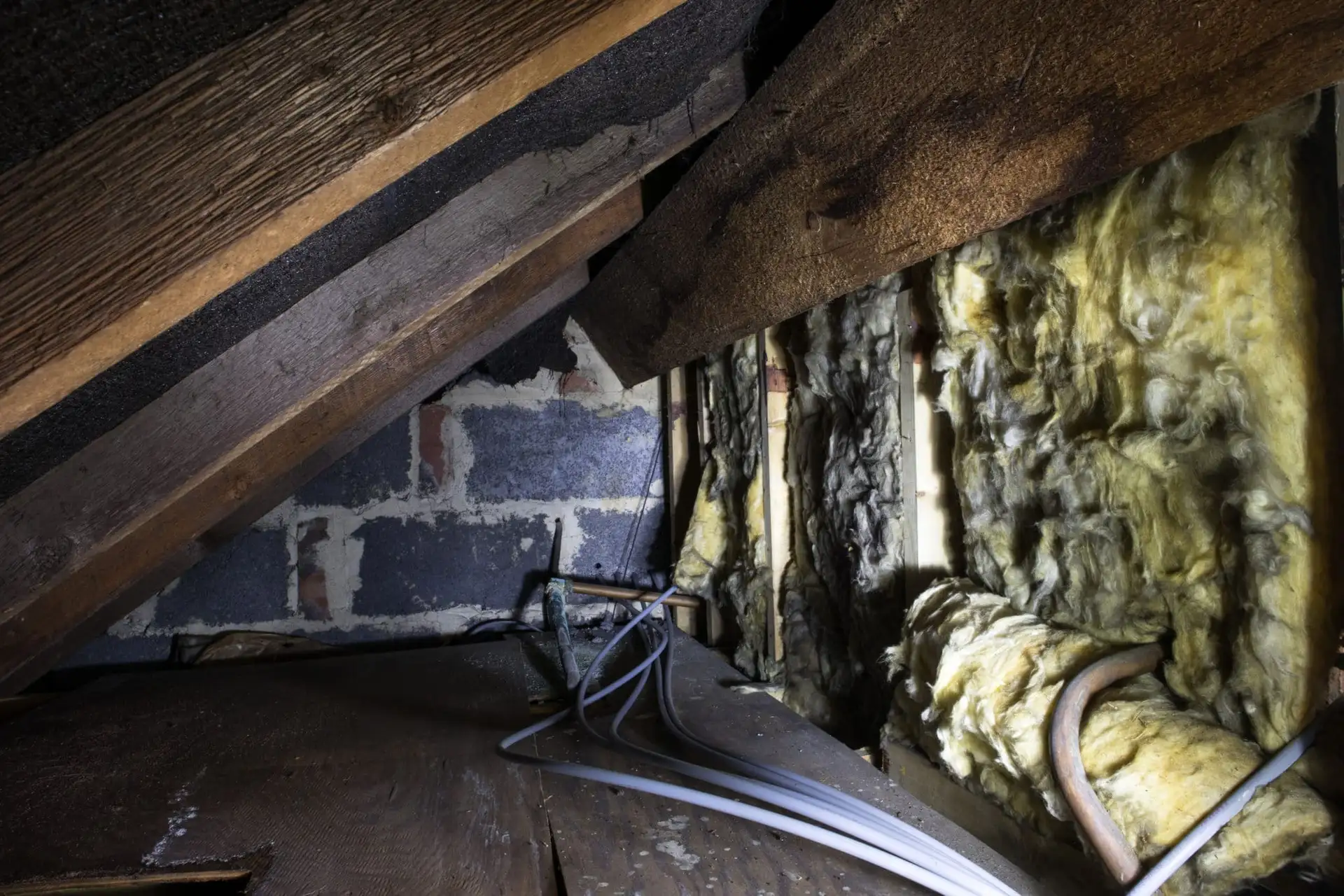
Mold on Your Crawl Space Framing Is a Structural Warning Sign, Not Just a Health Concern
Mold growth on floor joists and beams indicates moisture conditions severe enough to eventually cause wood rot and structural failure across Middle Tennessee homes.
Not sure which fix applies to your situation? Browse our full range of solutions for framing repair.
[ 01 ] Watch For These Signs
Signs That Mold Is Present on Crawl Space Framing
White, Black, or Green Fuzzy Growth on Wood Surfaces
Visible mold colonies on floor joists, rim joists, or beams appear as fuzzy, powdery, or patchy discoloration. Color ranges from white and gray to green, black, or brown depending on the mold species. Any visible mold in a crawl space should be professionally assessed.
Persistent Musty Odor Entering Living Areas
Musty odors from the crawl space migrate upward through gaps in the subfloor, around plumbing penetrations, and through HVAC systems. If parts of your home smell damp, stale, or earthy, the crawl space is often the source. The smell is produced by mycotoxins and volatile compounds released by active mold colonies.
Increased Allergy or Respiratory Symptoms in Occupants
Occupants who experience worsening allergy symptoms, frequent headaches, or unexplained respiratory irritation at home may be reacting to mold spores that have migrated from the crawl space into the living environment. This is especially noticeable if the HVAC air handler is located in the crawl space.
Stained or Discolored Insulation Under the Floor
Batt insulation hanging from the underside of the floor often shows water staining, discoloration, or sagging when the crawl space is persistently damp. This condition is frequently accompanied by mold growth on the wood framing directly above the insulation.
Mold spores are ubiquitous in any environment and only need moisture and an organic food source to begin growing. Wood framing provides the food source, and a crawl space humidity level above 60 percent provides the moisture. Middle Tennessee's climate routinely drives uncontrolled crawl spaces well above that threshold, particularly during late spring, summer, and fall.
During humid summer months, warm moist air that infiltrates a crawl space encounters cooler subfloor surfaces and foundation walls, causing condensation to form directly on wood framing. This surface moisture is sufficient to initiate mold colonization even if there is no visible water intrusion.
A missing or inadequate vapor barrier allows continuous moisture evaporation from the soil beneath the home. This keeps the crawl space humidity elevated far above levels safe for wood framing. Without addressing the ground moisture source, any mold treatment is only temporary.
Flooding or chronic water entry from grading issues, failed gutters, or sump pump problems saturates framing members and introduces large quantities of mold spores in a short period. Mold can begin growing within 24 to 48 hours of framing being wetted, and established colonies are difficult to eradicate without addressing both the moisture and the spore load.
[ 03 ] Recommended Solutions
How Ground Up fixes this
[ 04 ] Regional Context
Why Middle Tennessee foundations fail
Middle Tennessee's expansive clay soils shrink in dry summers and swell after rain, cycling significantly in volume. Davidson, Williamson, and Rutherford County homes built on this clay face ongoing movement pressure. Ground Up diagnoses and permanently stabilizes foundations across the region.
I always tell homeowners that mold in the crawl space is the canary in the coal mine for framing damage. It means moisture is high enough, and has been high enough long enough, that the wood is at serious risk. We treat the mold, we fix the moisture problem, and then we assess the framing to see how much structural work has already been done by the rot. The earlier we get in, the better the outcome.
[ 05 ] Why Ground Up
The difference is in the diagnosis
Get several quotes and you'll see a wide range of prices. The gap isn't luck. It's whether the contractor finds the actual cause and stands behind the work.
- In-house certified crews: we never subcontract your repair
- Optional independent third-party engineer review on larger jobs
- Honest three-tier triage: we tell you what can wait, in writing
- Family owned from the same Shelbyville Highway address since 2009
[ 06 ] FAQ
Mold on Crawl Space Framing questions
Surface mold alone does not directly cause structural weakening, but it is a reliable indicator that conditions are wet enough to eventually cause wood rot, which does. Some mold species also digest wood components over time. More importantly, the moisture conditions that support mold will support rot fungi too. We treat the mold and address the moisture to protect the long-term structural integrity of the framing.
DIY mold cleaning in a crawl space is not recommended for several reasons. First, without addressing the moisture source, mold will return within weeks. Second, disturbing mold colonies without proper containment and protective equipment significantly increases spore exposure risk. Third, it is very difficult to assess from the surface whether rot has begun beneath the mold. A professional assessment is the right starting point.
Yes. Research consistently shows that a significant portion of the air in a home originates from the crawl space below due to the stack effect, where pressure differentials draw air upward. Mold spores, mycotoxins, and musty odors from the crawl space regularly migrate into living areas. Addressing crawl space mold is a meaningful indoor air quality improvement.
Tennessee law generally requires sellers to disclose known material defects. Mold in a crawl space discovered during your ownership would likely qualify. Addressing the mold and its underlying moisture cause before listing is strongly advisable, both to protect you legally and to avoid the deal-killing stigma of an active mold issue being flagged in a buyer's inspection.
Mold remediation focuses on removing mold colonies from surfaces and controlling spore counts. Structural framing repair addresses joists and beams that have been weakened by rot. The two often go together in a crawl space, but they are distinct scopes of work. Ground Up performs framing repair and can coordinate mold remediation with qualified partners when needed.
More Problem Signs
Other signs to watch for
Broken or Cracked Floor Joists in the Crawl Space
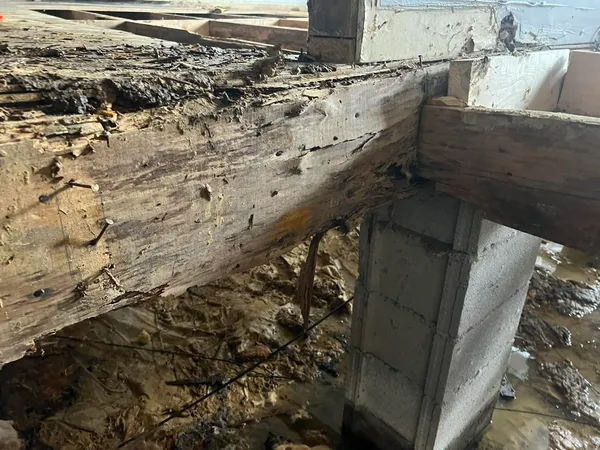
Floor joists are the horizontal framing members that span between the foundation walls or beams and support the subfloor, and everything above it. Broken or cracked joists occur when a single joist or multiple joists fail due to overloading, moisture-induced decay, insect damage, or improper notching and boring during past repairs. The result is a floor system that flexes, sags, or bounces in the affected area, and a structural problem that grows worse with continued loading.
Pest Damage to Wood Framing
Pest damage to crawl space framing is uniquely dangerous because it is almost entirely concealed during its active phase. Termites, carpenter ants, and wood-boring beetles do their damage inside dimensional lumber, hollowing out the structural core while the exterior surface may appear intact. By the time floors begin to feel soft, sag, or creak noticeably, the framing has typically already lost a significant percentage of its load-bearing cross-section. In Middle Tennessee, where subterranean termites are endemic and damp crawl spaces provide ideal nesting conditions, pest damage is a leading contributor to framing failure.
Rotted Deck Joists
Deck joists are exposed to weather in a way that interior floor joists are not. Rain, snow melt, condensation, and seasonal moisture cycling make deck framing the part of any home most vulnerable to rot. In Middle Tennessee's humid subtropical climate, untreated deck wood can begin to show meaningful rot within a few years if the deck design does not allow for adequate drainage and drying. Rotted deck joists are particularly dangerous because the damage is often invisible from above, the decking boards look fine while the structure beneath them has lost significant load capacity.
Rotted Floor Joists
Wood rot is caused by fungi that consume the cellulose and lignin that give wood its strength. Once rot establishes in a floor joist, it is not reversible, the destroyed wood fibers cannot regenerate. A joist in early-stage rot loses stiffness; in advanced rot, it loses load capacity. Middle Tennessee crawl spaces are particularly prone to wood rot because of the region's high annual rainfall, clay soils that hold moisture, and seasonal temperature swings that drive condensation on framing members. Without moisture control, rot in one joist spreads to adjacent framing, sill plates, and subfloor sheathing.
Sagging Floor Joists
Floor joists are designed to span horizontally between supports and resist the vertical loads placed on them. When a joist sags, it has deflected beyond acceptable limits, meaning the wood is bending more than it should under normal household loads. Sagging joists produce floors that feel bouncy or soft, tile finishes that crack, and in serious cases, floors that visibly slope toward a low point. In Middle Tennessee crawl space homes, joist sagging is driven by moisture deterioration, inadequate mid-span support, or original framing that was undersized for the span.
Soft or Weak Floors
Soft, spongy, bouncy, or visibly sagging floors are a clear signal that the structural framing beneath your home is compromised. Floor joists and support beams in crawl spaces are particularly vulnerable in Middle Tennessee, where high annual rainfall, clay soils, and humid summers create persistently damp conditions. When wood framing absorbs moisture over months or years, it softens, loses load-bearing capacity, and eventually rots, leaving your floors with no solid support.
Seeing these signs in your home?
We'll find the cause and tell you honestly what it needs, free.