
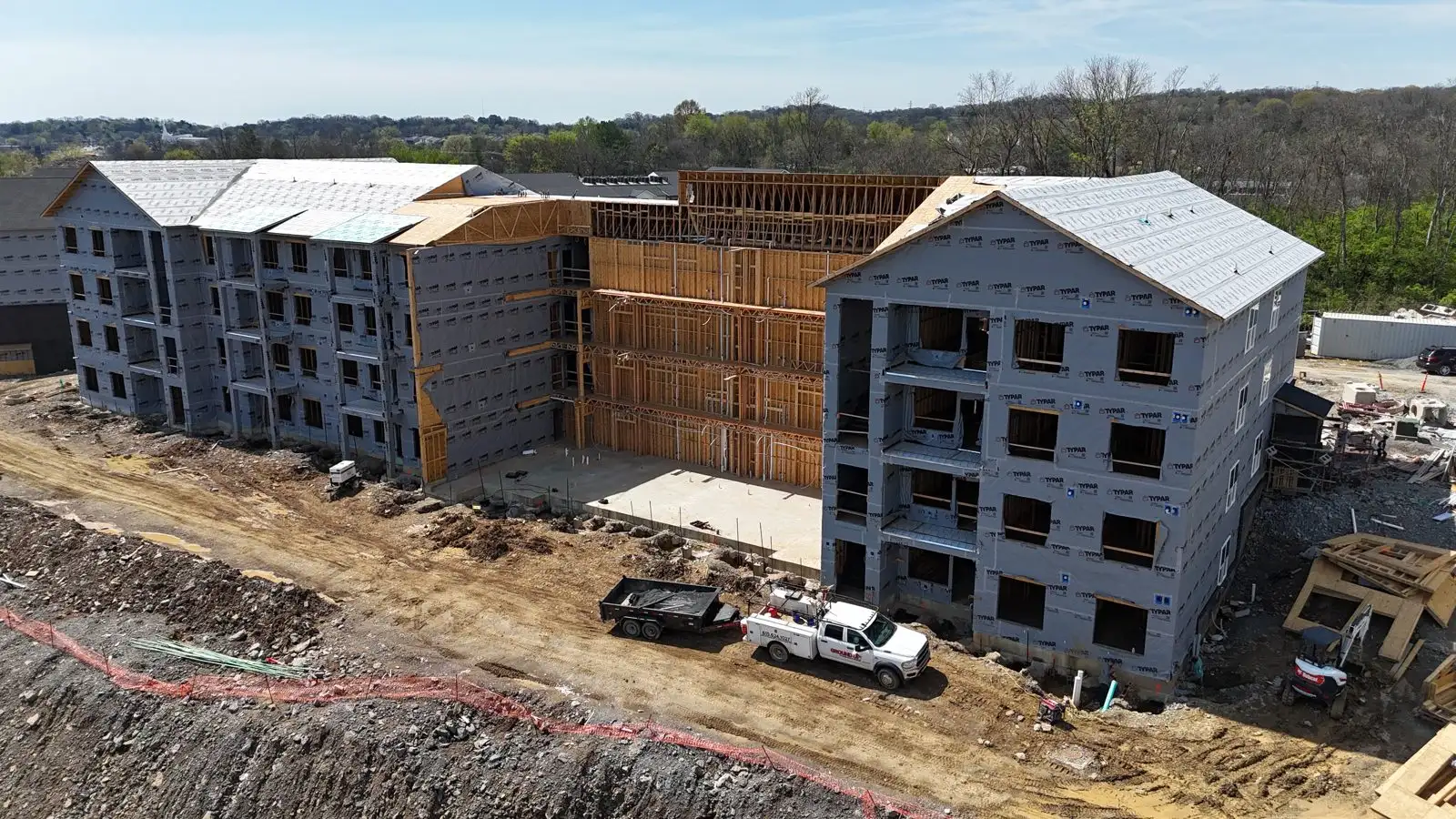
Foundation Movement in Multi-Family Buildings, Catching It Before It Becomes a Crisis
Differential settlement in apartment complexes and condominium buildings in Kentucky, Georgia, Alabama, Indiana, and Tennessee. Stabilize the foundation without disrupting tenants.
Not sure which fix applies to your situation? Browse our full range of solutions for commercial.
[ 01 ] Watch For These Signs
Signs that indicate foundation movement
Multiple unit complaints about sticking doors or windows in the same building section
Sticking doors and windows in isolated units are routine maintenance. When multiple units in the same building section report the same issue simultaneously, it points to building-wide movement.
Diagonal cracks at door and window corners in adjacent units
Diagonal cracks running from the corners of openings toward exterior walls are a consistent signature of differential foundation settlement.
Exterior building cracks following a diagonal or stair-step pattern
Exterior cracks visible on a multi-family building elevation that follow a diagonal or stair-step pattern in the masonry are a sign of differential settlement.
Sloped floors or unit-to-unit floor elevation differences in corridors
A corridor floor that has a perceptible slope indicates slab or floor framing movement driven by settlement beneath the building.
A multi-family building footprint often spans multiple soil types. Across Kentucky, Georgia, Alabama, Indiana, and Tennessee, it is common to find red clay in one area, residual limestone in another, and fill material in a third, all beneath the same building.
Red clay across Kentucky, Georgia, Alabama, Indiana, and Tennessee is significantly more active at the perimeter of a building than in the interior, because the perimeter soil is more exposed to seasonal moisture variation.
Multi-family developments in high-growth areas across Kentucky, Georgia, Alabama, Indiana, and Tennessee were sometimes constructed on inadequately prepared subgrades.
Long-term plumbing leaks beneath a multi-family building can erode subsoil beneath the slab or spread water through the subgrade.
[ 03 ] Recommended Solutions
How Ground Up fixes this
[ 04 ] Regional Context
Why foundations fail in Kentucky, Georgia, Alabama, Indiana, and Tennessee.
Expansive clay soils across Kentucky, Georgia, Alabama, Indiana, and Tennessee shrink in dry summers and swell after rain, cycling significantly in volume. Commercial and multi-family buildings built on this clay face ongoing movement pressure. Ground Up diagnoses and permanently stabilizes foundations across the region.
Multi-unit foundation problems almost always show up in individual unit complaints first. The challenge for property managers is recognizing when a pattern of complaints is really a building-level structural issue.
[ 05 ] Why Ground Up
The difference is in the diagnosis
Get several quotes and you'll see a wide range of prices. The gap isn't luck. It's whether the contractor finds the actual cause and stands behind the work.
- In-house certified crews: we never subcontract your repair
- Optional independent third-party engineer review on larger jobs
- Honest three-tier triage: we tell you what can wait, in writing
- Family owned from the same Shelbyville Highway address since 2009
[ 06 ] FAQ
Multi-Unit Foundation Movement questions
Yes. Helical and push pier installation does not require tenants to vacate their units in most cases. Work is done at the building perimeter or in targeted interior locations, coordinated with building management.
For multi-family buildings with finished interiors and long-term settlement, stabilization in current position is usually the correct approach. Lifting risks cracking finishes in ways that can create more damage than the settlement itself.
More Problem Signs
Other signs to watch for
Cart Path Slab Settlement
Golf course cart path settlement creates two problems that course operators deal with every season: safety liability and player experience. A cart path with stepped joints or lifted slab edges creates a bump hazard for cart traffic. In Middle Tennessee, where wet springs and dry summers cycle through reliably every year, cart path settlement is a predictable maintenance issue on courses built on the region's expansive clay soils.
Commercial Slab Settlement
Commercial slab settlement occurs when the soil beneath a concrete slab loses its bearing capacity, causing sections of the slab to drop below their original elevation. In Middle Tennessee commercial buildings, this shows up as uneven warehouse floors that create forklift hazards, settled loading dock aprons that gap at the building wall, and cracked retail and office floors visible through flooring.
Failing Retaining Walls
A failing retaining wall in a commercial setting is both a structural liability and a safety concern. Commercial retaining walls experience significant lateral soil pressure from Middle Tennessee's expansive red clay, and where wall drainage is inadequate, trapped groundwater adds hydrostatic pressure, extra force from water pushing against the wall, on top of that soil load. When that combined pressure exceeds the wall's original design capacity, the wall begins to deflect, tilt, or slide outward. Warning signs appear gradually: hairline cracks that widen over months, surface staining from water weeping through the wall, bulging in wall sections, and gaps opening at wall-to-footing joints.
Grain Bin Foundation Failure
Grain bin foundation failure in Middle Tennessee most commonly presents as settlement of the concrete ring or pad beneath the bin, separation between the bin ring and the foundation, and tilting of the bin structure. A grain bin foundation that has settled unevenly changes the bin's structural load distribution and creates gaps where moisture and pests can enter storage.
Solar Array Ground Issues
Solar array ground mount systems in Middle Tennessee depend on the pier foundations beneath them to hold position through decades of wind load, panel weight, and seasonal soil movement. When ground mount foundations are inadequate, the first signs appear as panel tilt, row misalignment, or visible movement in the racking structure.
Seeing these signs in your home?
We'll find the cause and give you a straight, written scope.