
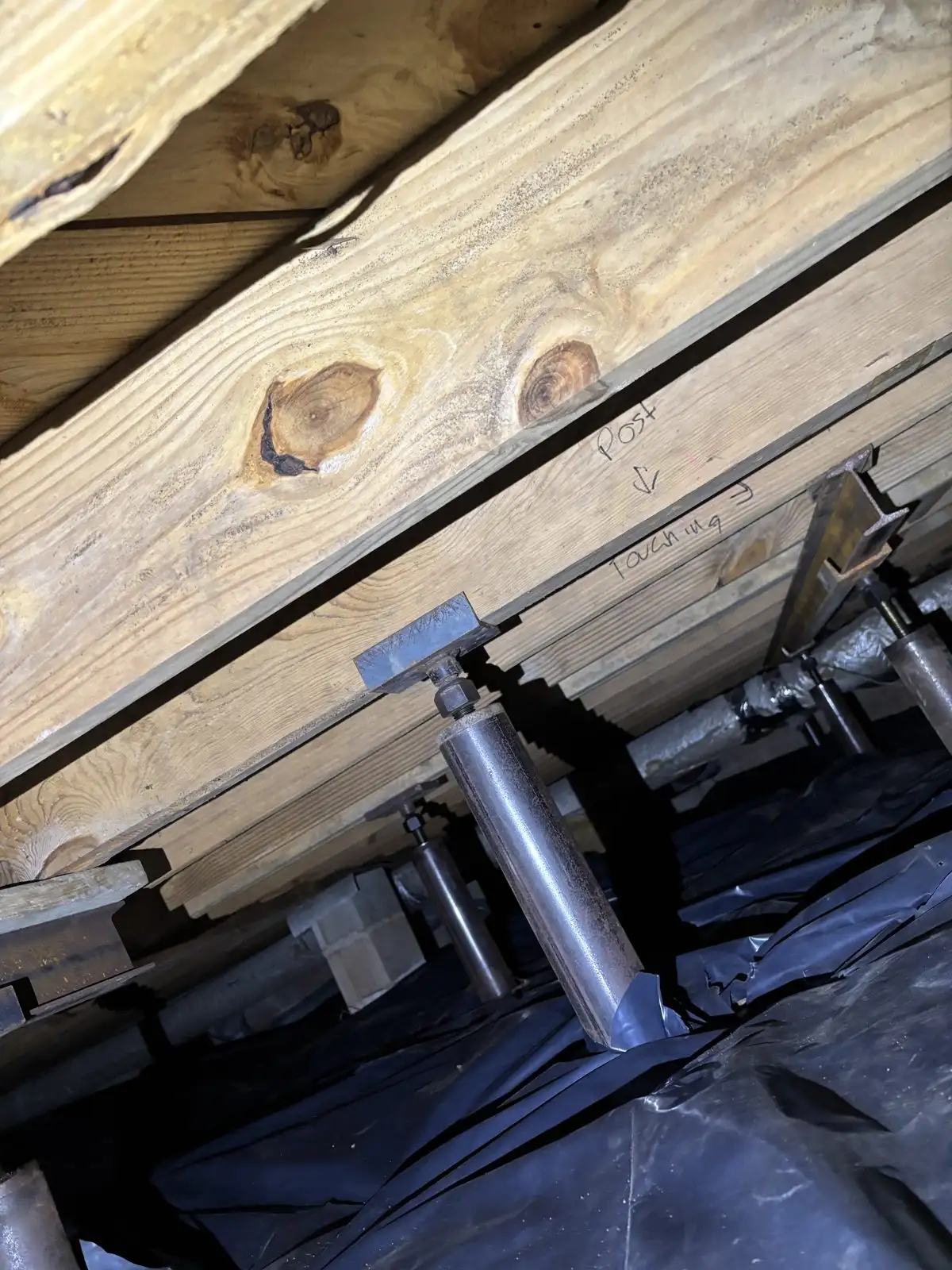
Soft or Weak Floors? Your Crawl Space Framing May Be Failing
In Middle Tennessee's humid climate, moisture-damaged floor joists are the leading cause of soft, spongy floors and the problem only gets worse without intervention.
When rotted joists, a sagging beam or a failed post is behind the soft spots, read about our repairs for sagging and soft floors. Not sure which fix applies to your situation? Browse our full range of solutions for framing repair.
[ 01 ] Watch For These Signs
Warning Signs Your Floor Framing Is in Trouble
Floors That Flex or Bounce Under Normal Weight
Healthy floor systems feel solid underfoot. If walking across a room causes noticeable flex, bounce, or a trampoline-like sensation, the joists beneath have lost stiffness due to moisture absorption or partial decay.
Visible Dips or Waves in the Floor Surface
A floor surface that is no longer level, showing dips toward the center of a room or near exterior walls, often indicates a compromised joist or beam beneath. Use a long level or a marble test to confirm whether the floor is truly out of plane.
Squeaking or Cracking Noises When Walking
Persistent squeaking that worsens over time, especially concentrated in one area, can indicate that joists have swollen, dried, and separated from the subfloor, or that fasteners are pulling through soft, rotted wood.
Doors or Cabinets That Stick or Swing Open on Their Own
Structural settlement caused by failing floor framing can shift the floor plane and affect door frames throughout the home. Doors that suddenly stick, refuse to latch, or drift open can be an indirect sign of floor system movement.
Middle Tennessee averages roughly 47 inches of rain per year, and clay-heavy soils hold that moisture against foundation walls and beneath crawl spaces. Floor joists that are continuously exposed to high humidity or standing water absorb moisture, swell, soften, and decay, losing the structural strength needed to support floor loads above.
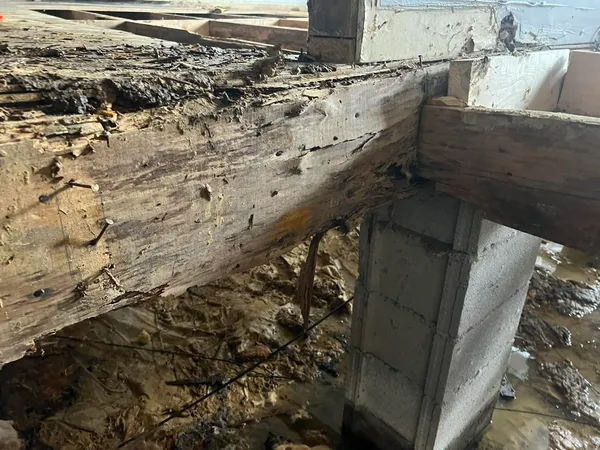
Girder beams and center support beams are often the first structural members to show signs of decay in a damp crawl space. Once rot takes hold in the beam, the joists it carries lose their mid-span support and the floor above deflects noticeably under foot traffic.
Termites, carpenter ants, and wood-boring beetles thrive in the warm, humid crawl spaces common across Middle Tennessee. These pests hollow out floor joists from the inside, leaving the exterior shell intact while gutting the structural core. Floors may feel fine until the damage is severe.
Older homes built before modern crawl space moisture management standards are especially susceptible. Untreated wood framing installed decades ago without a vapor barrier accumulates moisture damage over time, compounding with each wet Tennessee season until structural failure occurs.
Crawl spaces without a proper vapor barrier allow ground moisture to evaporate directly into the enclosed space. Combined with inadequate ventilation, relative humidity inside the crawl space can stay above 70 percent year-round, which is sufficient to sustain wood rot fungi and accelerate framing decay.
[ 03 ] Recommended Solutions
How Ground Up fixes this
[ 04 ] Regional Context
Why Middle Tennessee foundations fail
Middle Tennessee's expansive clay soils shrink in dry summers and swell after rain, cycling significantly in volume. Davidson, Williamson, and Rutherford County homes built on this clay face ongoing movement pressure. Ground Up diagnoses and permanently stabilizes foundations across the region.
Soft floors are one of the most misunderstood symptoms we encounter. Homeowners assume it is just an old house settling, but when we get into the crawl space, we almost always find joists that have been quietly rotting for years because moisture was never addressed. The floor is the last thing to show symptoms, not the first.
[ 05 ] Why Ground Up
The difference is in the diagnosis
Get several quotes and you'll see a wide range of prices. The gap isn't luck. It's whether the contractor finds the actual cause and stands behind the work.
- In-house certified crews: we never subcontract your repair
- Optional independent third-party engineer review on larger jobs
- Honest three-tier triage: we tell you what can wait, in writing
- Family owned from the same Shelbyville Highway address since 2009
[ 06 ] FAQ
Soft or Weak Floors questions
Soft floors caused by damaged crawl space framing are a serious structural problem, not a cosmetic one. The floor joists and beams beneath your home are designed to carry the weight of everything above them. When they are compromised by moisture, rot, or pests, they lose load-bearing capacity and can eventually fail. We recommend getting a professional inspection as soon as you notice floor softness.
In the humid conditions common across Middle Tennessee, particularly in unconditioned crawl spaces without vapor barriers, wood rot can progress from early-stage moisture damage to significant structural weakness within two to three years. Hot, humid summers accelerate the growth of wood rot fungi. Early intervention is always less costly than waiting.
Not in most cases. Soft floors caused by framing damage require repairs to the structural members in the crawl space, specifically the joists and beams. Surface-level repairs such as new flooring or subfloor patches will not restore structural integrity and will likely fail again. A crawl space inspection is the necessary first step.
In many cases, yes. Squeaking caused by softened or separated framing members often resolves after the damaged joists are sistered or replaced and the subfloor is re-secured. If squeaking persists after structural repairs, it may be coming from the subfloor-to-finish-floor connection, which is a separate issue.
Typically, no. Most homeowners insurance policies exclude gradual damage caused by moisture, humidity, or lack of maintenance. Coverage may apply if the damage resulted from a sudden covered event such as a burst pipe. We recommend reviewing your policy and speaking with your insurer, and we can provide detailed documentation of the damage to support any claim you pursue.
More Problem Signs
Other signs to watch for
Broken or Cracked Floor Joists in the Crawl Space
Floor joists are the horizontal framing members that span between the foundation walls or beams and support the subfloor, and everything above it. Broken or cracked joists occur when a single joist or multiple joists fail due to overloading, moisture-induced decay, insect damage, or improper notching and boring during past repairs. The result is a floor system that flexes, sags, or bounces in the affected area, and a structural problem that grows worse with continued loading.
Mold on Crawl Space Framing
Mold on crawl space framing is frequently discussed as a health issue, and it absolutely is one. But in the context of structural framing, mold is also one of the earliest and most reliable indicators that moisture conditions are severe enough to eventually cause wood rot. The same high humidity that allows mold to colonize the surface of floor joists and beams will, over time, allow rot fungi to penetrate and degrade the structural core of the wood. Catching and correcting mold on framing early is an opportunity to prevent the costlier structural repairs that follow if conditions persist.
Pest Damage to Wood Framing
Pest damage to crawl space framing is uniquely dangerous because it is almost entirely concealed during its active phase. Termites, carpenter ants, and wood-boring beetles do their damage inside dimensional lumber, hollowing out the structural core while the exterior surface may appear intact. By the time floors begin to feel soft, sag, or creak noticeably, the framing has typically already lost a significant percentage of its load-bearing cross-section. In Middle Tennessee, where subterranean termites are endemic and damp crawl spaces provide ideal nesting conditions, pest damage is a leading contributor to framing failure.
Rotted Deck Joists
Deck joists are exposed to weather in a way that interior floor joists are not. Rain, snow melt, condensation, and seasonal moisture cycling make deck framing the part of any home most vulnerable to rot. In Middle Tennessee's humid subtropical climate, untreated deck wood can begin to show meaningful rot within a few years if the deck design does not allow for adequate drainage and drying. Rotted deck joists are particularly dangerous because the damage is often invisible from above, the decking boards look fine while the structure beneath them has lost significant load capacity.
Rotted Floor Joists
Wood rot is caused by fungi that consume the cellulose and lignin that give wood its strength. Once rot establishes in a floor joist, it is not reversible, the destroyed wood fibers cannot regenerate. A joist in early-stage rot loses stiffness; in advanced rot, it loses load capacity. Middle Tennessee crawl spaces are particularly prone to wood rot because of the region's high annual rainfall, clay soils that hold moisture, and seasonal temperature swings that drive condensation on framing members. Without moisture control, rot in one joist spreads to adjacent framing, sill plates, and subfloor sheathing.
Sagging Floor Joists
Floor joists are designed to span horizontally between supports and resist the vertical loads placed on them. When a joist sags, it has deflected beyond acceptable limits, meaning the wood is bending more than it should under normal household loads. Sagging joists produce floors that feel bouncy or soft, tile finishes that crack, and in serious cases, floors that visibly slope toward a low point. In Middle Tennessee crawl space homes, joist sagging is driven by moisture deterioration, inadequate mid-span support, or original framing that was undersized for the span.
Seeing these signs in your home?
We'll find the cause and tell you honestly what it needs, free.