
Drywall Cracks: Which Ones Are Foundation Warning Signs
Hairline cracks in fresh drywall are often normal settling. Diagonal cracks at door corners, recurring cracks, and cracks with displacement are structural warnings.
Not sure which fix applies to your situation? Browse our full range of solutions for foundation repair.
[ 01 ] Watch For These Signs
Drywall Cracks That Indicate Foundation Movement
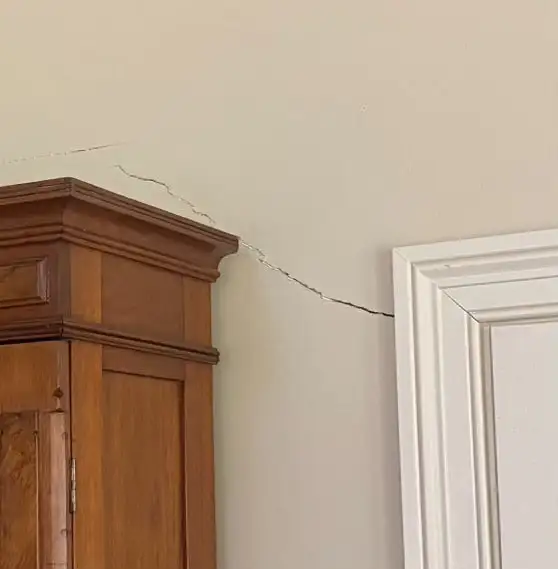
Diagonal cracks radiating from door or window corners
These are the most reliable drywall indicator of foundation movement. The 45-degree crack from the corner of an opening follows the path of diagonal tension created when the opening's frame racks out of square.
Cracks that have appeared and reappeared in the same location
If you or a previous owner have patched a crack and it has come back, the underlying movement has not stopped. Recurring cracks in the same location confirm active, ongoing foundation movement.
Cracks with offset or displacement
When one side of a drywall crack is visibly higher or lower than the other, the framing on either side of the crack has moved in different vertical planes. This is a serious sign of significant differential movement.
Cracks running horizontally at mid-wall height
Horizontal cracks at roughly mid-height on a wall, especially if the wall bulges outward, can indicate lateral pressure on a basement or foundation wall, which is a separate but equally serious condition.
Differential foundation settlement puts framing in diagonal tension, cracking the drywall along the tension line radiating from door and window corners.
Repeated annual cycles of foundation movement from soil wetting and drying cause cracks that open in summer and partially close in winter, gradually widening over years.
Hairline cracks at taped drywall joints and in corners during the first year of a new home's life are typically caused by lumber drying and drywall compound shrinkage, not foundation movement.
Homes without adequate expansion at wall intersections and ceiling planes can develop cosmetic cracks from thermal cycling. These are usually straight and at consistent locations.
[ 03 ] Recommended Solutions
How Ground Up fixes this
[ 04 ] Regional Context
Why Middle Tennessee foundations fail.
Middle Tennessee's expansive Maury and Dickson series clay soils shrink in dry summers and swell after rain, cycling by up to 15% in volume. Davidson, Williamson, and Rutherford County homes built directly on this clay face ongoing movement pressure. Ground Up diagnoses and permanently stabilizes foundations across the region.
The first thing I look for in any interior is diagonal cracks at door corners. If I see two or three of them in the same wing of the house, I'm already formulating a theory about where the foundation is moving before I look at anything else.
[ 05 ] Why Ground Up
The difference is in the diagnosis
Get several quotes and you'll see a wide range of prices. The gap isn't luck. It's whether the contractor finds the actual cause and stands behind the work.
- In-house certified crews: we never subcontract your repair
- Optional independent third-party engineer review on larger jobs
- Honest three-tier triage: we tell you what can wait, in writing
- Family owned from the same Shelbyville Highway address since 2009
[ 06 ] FAQ
Drywall Cracks questions
As a general rule, cracks wider than 1/8 inch at any point, or cracks of any width that show displacement between the two edges, should be evaluated. Width alone is less important than pattern, location, and whether the crack is actively growing.
We recommend leaving cracks visible for the inspection. The pattern, width, and displacement of the cracks provide diagnostic information. After the foundation is assessed and any needed repairs are completed, patching and repainting makes sense.
Foundation repair stops the cracking from continuing and in many cases allows partial closure of existing cracks. After the foundation is stabilized, the cracks can be professionally patched. They are unlikely to reopen once the underlying movement has stopped.

Free guide
Get the free foundation settlement guide
- A room by room checklist of warning signs
- How Middle Tennessee red clay can move a house
- What happens at a free inspection
Your guide is on its way.
Check your inbox for an email from Ground Up Foundation Repair. If it is not there in a few minutes, check your spam or promotions folder.
More Problem Signs
Other signs to watch for
Bouncing or Springy Floors
A floor that bounces when you walk across it, feels spongy or soft in specific areas, or vibrates noticeably when someone moves in an adjacent room is a floor that lacks adequate structural support below it. In Middle Tennessee, this symptom is most common in pier-and-beam homes, houses with a crawl space beneath the living area, where the supporting wood beam and joist system has been weakened by moisture, age, or original under-construction.
Bowing Basement Walls
A bowing basement wall has visibly deflected inward from the outside soil pressure pressing against it. In Middle Tennessee, the region's expansive red clay absorbs moisture and swells against foundation walls, generating lateral pressure that concrete block, brick, and even poured concrete walls cannot always resist indefinitely. What starts as a hairline crack can progress to a visible curve in the wall face, and once a wall begins moving, the cycle accelerates.
Carpenter Ant Infestation
Carpenter ants are often mistaken for a pest problem requiring only extermination. In reality, carpenter ants are an indicator species: they preferentially colonize wood that has been softened by moisture, rot, or previous insect damage. When carpenter ants are found inside a home, particularly in the lower levels, near the perimeter walls, or in the crawl space, they are pointing to a wood moisture problem in the foundation framing. That moisture problem is almost always the result of inadequate crawl space drainage, failed vapor barriers, high humidity, or standing water in the crawl space that has been saturating the sill plates, floor joists, and beams for months or years.
Cracked Block Foundation Walls
Concrete masonry unit (block) foundation walls are common in Middle Tennessee homes built from the 1950s through the 1990s. Unlike poured concrete walls, block foundations are built in courses with mortar joints, making them both more permeable and more susceptible to cracking at the joint locations. Cracks in block foundations are classified by their orientation: horizontal cracks indicate bending failure from lateral soil pressure and are the most structurally serious. Vertical cracks indicate settlement or shrinkage. Stair step cracks indicate differential settlement at the corner. Shear cracks that displace one side of the wall vertically relative to the other indicate advanced structural failure. Each pattern requires a different evaluation approach.
Cracked Bricks
Brick veneer on residential homes is not a structural element. It is a decorative cladding attached to the wood-frame structure behind it. When the foundation moves, the wood frame moves with it, and the brick veneer moves too, but because brick is rigid and the mortar joints are weaker than the brick units themselves, the movement is expressed as cracking along the mortar joints or, in severe cases, through the brick faces themselves. The pattern of cracking reveals the direction and cause of the underlying foundation movement. Stair step cracks indicate differential settlement. Horizontal cracks indicate lateral loading on a foundation wall. Vertical cracks at corners indicate shear from differential settlement at a corner footing.
Cracks at Door Frames, Ceilings, and Corners
Cracks at door frames, ceiling-to-wall junctions, and interior corners are concentration points for stress in a building's structure. When the foundation moves, the framing above it distorts, and the rigid drywall and plaster finish materials crack at these high-stress junctions. The pattern of cracking at corners and ceiling lines is diagnostically useful: cracks at inside corners between walls indicate in-plane racking of the framing. Cracks along the ceiling-to-wall junction indicate differential vertical movement between the wall and the floor or ceiling structure above. Cracks radiating from door frame corners are the most classic foundation settlement indicator.
Seeing these signs in your home?
We'll find the cause and tell you honestly what it needs, free.