
Polyjacking: Fast, Lightweight Slab Lifting with Polyurethane Foam
Small holes, quick cure, long-lasting lift, the modern alternative to traditional mud jacking.
On cost: $800–$2,500 per panel or area.
Overview
Polyurethane Foam Injection (Polyjacking)
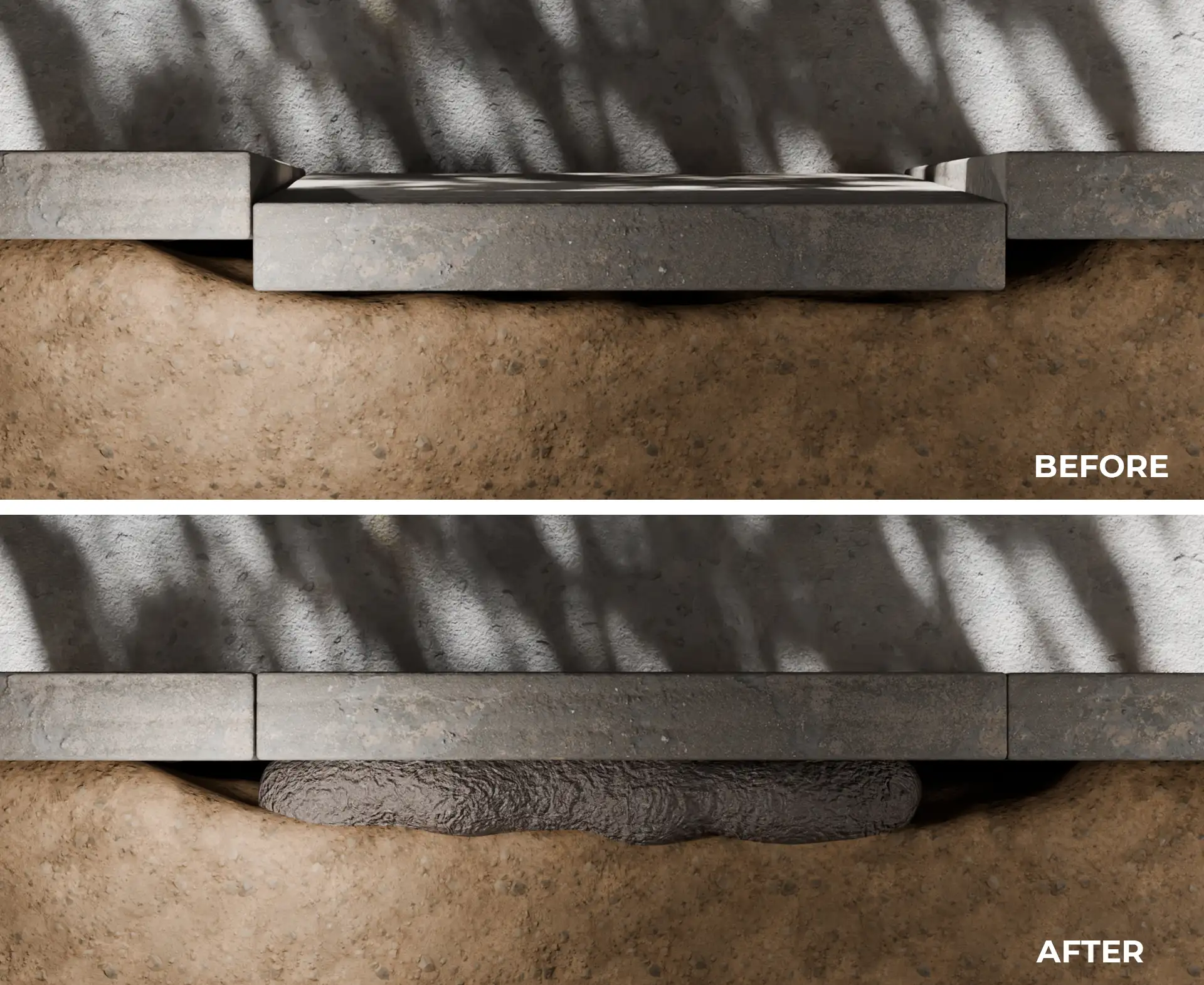
Polyurethane foam injection, called polyjacking or slab jacking, lifts settled concrete by injecting high-density expanding foam through 5/8-inch holes drilled in the slab. The foam expands to fill voids beneath the concrete and generates enough upward pressure to lift the slab back to grade, then cures rigid within minutes. It's the fastest and least invasive method for lifting sunken driveways, garage floors, pool decks, sidewalks, and interior slabs across Middle Tennessee. Because the foam is lightweight and water-resistant, it doesn't add load to the soil and won't wash out or compress over time the way soil-based fill can.
Two-component polyurethane foam (an isocyanate and a polyol resin) is heated to the proper viscosity and injected through small holes in the slab using a proportioning pump and heated hose. When the two components contact each other at the injection tip beneath the slab, they react and expand rapidly, typically 20 to 30 times their liquid volume, filling voids and applying upward pressure. The technician controls injection volume and monitors slab movement at multiple points to achieve uniform lift without over-raising any section. Once the target elevation is reached, injection stops and the foam cures rigid within 15 to 30 minutes. The small injection holes are plugged with cement mortar and finished flush. The total process from drilling to cleanup is usually completed in a few hours.
Wondering if this is the right fix for what you are seeing? Learn more about the warning signs: Cracked Floor Tiles and Sinking Foundation and Uneven or Sloping Floors . Or browse the full Problem Signs library for foundation repair.
Installation Process
How we install polyurethane foam injection (polyjacking)
Slab Assessment and Port Layout
We probe for voids, measure settlement with a level, and identify the slab's pivot points. Port locations are laid out to provide complete foam coverage beneath the sunken area, typically in a grid pattern with 2- to 4-foot spacing.
5/8-Inch Port Drilling
Small 5/8-inch holes are drilled through the slab at the marked port locations using a rotary hammer. These holes are significantly smaller than mud jacking ports and leave a less visible patch afterward.
Injection Tip Installation
A short injection tip (a small plastic or metal port) is inserted into each drilled hole to guide the foam beneath the slab and prevent blowback at the surface during injection.
Controlled Foam Injection and Lift Monitoring
Starting at the lowest or most settled area, foam is injected port by port. The technician watches for slab movement at adjacent reference points and injects in short bursts, allowing the foam to expand and stabilize before adding more. This iterative approach prevents over-lifting.
Foam Cure, 15 to 30 Minutes
Unlike mud jacking, which requires 24 hours before vehicle traffic, polyjacking foam cures rigid in 15 to 30 minutes. Once injection is complete at all ports, the foam is already setting while we move on to patching.
Port Patching and Site Cleanup
Each 5/8-inch port is plugged with cement mortar and finished flush with the slab surface. Foam overspray at the slab edges is trimmed. The area is cleaned and returned to service, vehicle traffic permitted within the hour in most cases.
Polyjacking is the right answer for most residential slab lifting. The ports are tiny, the foam is in there and hard in under an hour, and you're not waiting a day to use your driveway. For driveways, sidewalks, and pool decks, it checks every box.
Why Ground Up
The difference is in the diagnosis
Get several quotes and you'll see a wide range of prices. The gap isn't luck. It's whether the contractor finds the actual cause and stands behind the work.
- In-house certified crews: we never subcontract your repair
- Optional independent third-party engineer review on larger jobs
- Honest three-tier triage: we tell you what can wait, in writing
- Family owned from the same Shelbyville Highway address since 2009
FAQ
Polyurethane Foam Injection (Polyjacking) questions
Polyjacking uses expanding polyurethane foam; mud jacking uses a cement-soil slurry. Foam cures in minutes versus 24 hours for slurry. Foam ports are 5/8 inch versus 1.5 to 2 inches for mud jacking, leaving smaller patches. Foam is also lighter, it adds almost no load to the soil beneath the slab. For most residential driveways and sidewalks, polyjacking is faster and cleaner. For very large voids or heavy commercial slabs, mud jacking or grouting may be more appropriate.
Typically within 30 to 60 minutes of completion. The foam cures rigid fast, and there's no slurry-cure wait period. We'll confirm the exact return-to-service time based on the foam used and conditions on your project day.
No. High-density polyurethane foam is moisture-resistant and does not biodegrade in the ground. It won't wash out in heavy rain events, compress under slab load, or shrink over time. This is one of the reasons polyjacking results tend to last longer than traditional mud jacking in areas with heavy seasonal rainfall.
Yes. Pool decks are a common polyjacking application. The lightweight foam is especially well-suited because it doesn't add soil load near the pool shell, and the small ports leave minimal damage to decorative concrete surfaces. We take care around pool equipment and bonding wires during the process.
Polyjacking addresses the void and restores the slab to grade, but it doesn't fix the condition that caused the void in the first place. Poor drainage, plumbing leaks, and soil erosion need to be corrected to prevent recurrence. We identify contributing factors during the inspection and recommend corrections alongside the lifting work.

Free guide
Get the free foundation settlement guide
- A room by room checklist of warning signs
- How Middle Tennessee red clay can move a house
- What happens at a free inspection
Your guide is on its way.
Check your inbox for an email from Ground Up Foundation Repair. If it is not there in a few minutes, check your spam or promotions folder.
More Solutions
Other solutions we offer
Carbon Fiber Strap Installation
Carbon fiber straps are high-tensile-strength composite straps bonded vertically to the face of a bowing basement wall to prevent further inward deflection. The straps are made from the same carbon fiber used in aerospace and structural engineering applications, rated at tensile strengths far exceeding steel by weight. When epoxy-bonded to a properly prepared wall surface from floor plate to sill plate, carbon fiber straps transfer the lateral soil pressure load into the top and bottom bearing points of the wall system rather than allowing the wall face to deflect. Carbon fiber reinforcement is best suited for walls that have deflected less than 2 inches and have not experienced significant cracking through the wall section. It is a hold-in-place system, not a restoration system, it prevents further movement but does not push the wall back toward its original position.
Deep Foundation Systems
Deep foundation systems transfer structural loads from the ground surface to soil or rock at a depth where bearing capacity is reliable and unaffected by surface conditions. In Middle Tennessee, the primary driver for deep foundation work is the region's expansive clay geology: the top several feet of soil shrink in dry weather and swell in wet weather, making them unreliable bearing material for foundations that must remain stable year-round. Deep foundation elements including helical piers, push piers, and micropiles penetrate through this active zone and reach bedrock, dense gravels, or competent clay at depth where moisture variation has minimal effect. These systems are used for both new construction on difficult sites and for repair of existing foundations that have settled due to inadequate bearing in the near-surface soils. Ground Up designs and installs deep foundation systems for residential and light commercial applications throughout the Middle Tennessee region.
Epoxy Crack Injection
Epoxy crack injection is a structural repair method for concrete foundation walls, slabs, and beams that have developed cracks due to settlement, curing shrinkage, hydrostatic pressure, the outward force of water pushing against a foundation wall from saturated soil, or thermal movement. Low-viscosity epoxy resin is injected under low pressure through surface ports installed across the crack at regular intervals, filling the crack from its deepest point outward. As the epoxy cures, it bonds the two concrete faces together with tensile strength greater than the surrounding concrete. The result is a monolithic repair that restores the structural continuity of the cracked section. Epoxy injection is appropriate for dry or dormant cracks, cracks that are not actively wet and not in active movement. For cracks with active water seeping through them, polyurethane foam injection (which expands and seals in the presence of moisture) is often the appropriate first step, followed by epoxy once the wall has been dried out.
Expansion Joint Installation
Concrete is a rigid material that nonetheless moves with temperature, moisture, and loading. In Middle Tennessee's climate, with summer temperatures regularly exceeding 95 degrees and occasional hard freezes in winter, the thermal expansion and contraction of concrete slabs, driveways, sidewalks, and foundation walls is significant. When concrete cannot move freely, it builds up internal stress that is released suddenly as a crack. Expansion joints and control joints are planned gaps in the concrete that give it a place to move without cracking in the field of the slab or through a structural element. Ground Up installs expansion joints during new concrete work and cuts or installs retrofit joints in existing concrete to prevent crack propagation and protect adjacent structural elements from impact loading caused by slab movement.
Foundation Underpinning and Stabilization
Foundation underpinning, also called foundation stabilization, is the process of extending the effective depth of a foundation's bearing capacity by installing structural support elements that bypass inadequate near-surface soils and transfer load to competent material at depth. In Middle Tennessee, where expansive clay soils lose and regain bearing capacity with every moisture cycle, underpinning is the most durable long-term foundation repair strategy available. Ground Up installs two primary types of underpinning: helical pier underpinning, which uses rotating steel shafts with helical plates to reach bearing at a torque-confirmed depth; and push pier underpinning, which drives steel pipe sections hydraulically using the building's weight as a reaction force, meaning the home's own weight gives the hydraulic ram something to push against, until the pier reaches refusal in competent soil or rock. Both systems transfer the structural load from the clay soils that are causing settlement to deep bearing material that is unaffected by surface moisture variation, stopping settlement and in most cases allowing partial to full elevation recovery.
Concrete Piers for Foundation Support
Concrete piers are cast-in-place or pre-cast reinforced concrete elements that extend from the foundation footing down through unstable near-surface soils to a bearing stratum with adequate capacity. They are one of the most durable underpinning approaches available for residential and commercial foundations in Middle Tennessee, providing a permanent structural connection between the foundation and the stable soil or rock below the depth at which seasonal and moisture-driven soil movement occurs.
Found a problem? Get a straight answer
Free inspection, written estimate, honest triage. No pressure.