
I-Beam Bracing Stabilizes Bowing Foundation Walls Without Excavation
A foundation wall bowing inward under lateral soil pressure is a structural emergency. I-beam bracing arrests the movement and prevents further inward displacement, from the interior, without digging up the yard.
On cost: $4,000 to $12,000 depending on wall length, degree of bowing, and beam count.
Overview
I-Beam Wall Bracing for Bowing Foundation Walls
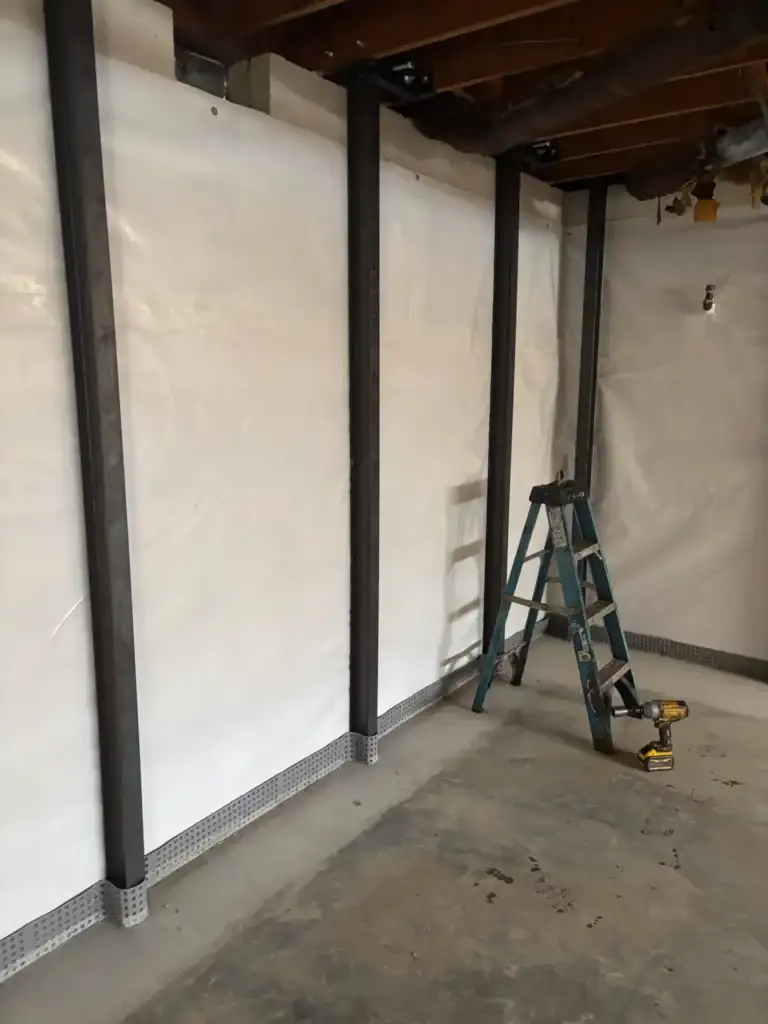
Foundation walls that bow inward are responding to lateral soil pressure exceeding the wall's original design capacity, often due to saturated soil, root pressure, frost, or loss of lateral support at the top or bottom of the wall. Left unaddressed, bowing progresses to cracking and, in severe cases, to collapse of the wall section. I-beam wall bracing systems install steel channels or I-beams vertically against the interior face of the wall, tied at the top to the floor structure and at the base to the footing. The beam assembly transfers the lateral soil load to the floor and footing, stabilizing the wall in its current position and preventing further inward movement.
Steel I-beams or channels are cut to span from the basement or crawl space floor to the floor structure above. The beam is placed against the bowing wall and connected at the top with a plate that anchors to the first-floor framing. At the base, the beam bears against the footing or is anchored to a base plate. The wall's outward tendency under soil pressure is restrained by the beam's resistance in bending. When the beams are installed at close intervals, typically 4 to 6 feet apart across the bowed section, they provide distributed resistance to the lateral load. Over time, gradual tightening of the anchor hardware at the top allows the wall to be slowly pushed back toward plumb.
Wondering if this is the right fix for what you are seeing? Learn more about the warning signs: Foundation Settlement and Cracks in Concrete Floors and Expansive Soil Damage to Foundations . Or browse the full Problem Signs library for foundation repair.
Installation Process
How we install i-beam wall bracing for bowing foundation walls
Wall Assessment and Documentation
We measure the degree of bowing using a level or digital gauge at multiple points across the wall. The amount of inward displacement determines the severity and informs the beam spacing and anchor design.
Top Anchor Installation
Anchor plates are bolted to the first-floor framing above the bowing wall. These plates will transfer the lateral load from the beam top into the floor diaphragm, which can resist it without distorting.
Beam Placement
Each I-beam or channel is positioned against the wall face, plumbed, and tightened into the top anchor. The beam bears against the footing or anchor plate at the bottom.
Base Connection
The bottom of each beam is connected to the footing or a base plate that distributes the reaction load. The base connection ensures the beam cannot slide horizontally as it carries the lateral load.
Monitoring Protocol
After installation, we establish a monitoring schedule for periodic re-tightening of the top anchors. The re-tightening process gradually moves the wall back toward plumb over months. We document the wall position at each visit to track recovery progress.
A bowing wall is the structure telling you the soil is winning. The beam changes that equation. It gives the wall something to push against from the inside that the soil cannot overcome. We stop the movement that day, and then we work on getting the wall back over time.
Why Ground Up
The difference is in the diagnosis
Get several quotes and you'll see a wide range of prices. The gap isn't luck. It's whether the contractor finds the actual cause and stands behind the work.
- In-house certified crews: we never subcontract your repair
- Optional independent third-party engineer review on larger jobs
- Honest three-tier triage: we tell you what can wait, in writing
- Family owned from the same Shelbyville Highway address since 2009
FAQ
I-Beam Wall Bracing for Bowing Foundation Walls questions
I-beam bracing immediately arrests inward movement. Recovering the wall toward plumb is achieved through gradual re-tightening of the top anchors over a period of months to years. The rate of recovery depends on wall stiffness, soil conditions, and how much inward displacement has already occurred. Walls with severe bowing may not fully return to plumb but can be stabilized in a structurally acceptable position.
No. I-beam bracing is entirely an interior installation. No excavation of the exterior is required, which distinguishes it from exterior wall anchor systems and wall rebuild approaches. This makes it significantly less disruptive and less expensive than excavation-based alternatives.
A foundation wall that is bowing inward is under active structural stress. The rate of progression determines the urgency. Walls with less than 2 inches of inward displacement that have been stable over a monitored period may be stabilized with interior bracing. Walls displacing more than 2 inches or showing active progression need prompt intervention. Walls at 4 or more inches of displacement may require rebuild. We measure and document wall displacement as the first step in every bowing wall evaluation.
Carbon fiber straps are bonded to the wall surface and provide tensile resistance to further inward movement. They are effective for early-stage bowing and provide a low-profile installation. I-beams provide significantly more resistance to lateral load and are appropriate for more advanced bowing or higher-load conditions. Both systems can be adjusted to allow wall recovery over time, though the mechanism differs. We select the appropriate system based on wall type, degree of bowing, and long-term recovery goals.
Beams are typically spaced 4 to 6 feet apart across the bowed section of the wall, with additional beams added where displacement is greatest. A 20-foot bowing wall section typically requires 4 to 6 beams. We calculate the required beam count and spacing based on the soil load and wall type.

Free guide
Get the free foundation settlement guide
- A room by room checklist of warning signs
- How Middle Tennessee red clay can move a house
- What happens at a free inspection
Your guide is on its way.
Check your inbox for an email from Ground Up Foundation Repair. If it is not there in a few minutes, check your spam or promotions folder.
More Solutions
Other solutions we offer
Carbon Fiber Strap Installation
Carbon fiber straps are high-tensile-strength composite straps bonded vertically to the face of a bowing basement wall to prevent further inward deflection. The straps are made from the same carbon fiber used in aerospace and structural engineering applications, rated at tensile strengths far exceeding steel by weight. When epoxy-bonded to a properly prepared wall surface from floor plate to sill plate, carbon fiber straps transfer the lateral soil pressure load into the top and bottom bearing points of the wall system rather than allowing the wall face to deflect. Carbon fiber reinforcement is best suited for walls that have deflected less than 2 inches and have not experienced significant cracking through the wall section. It is a hold-in-place system, not a restoration system, it prevents further movement but does not push the wall back toward its original position.
Deep Foundation Systems
Deep foundation systems transfer structural loads from the ground surface to soil or rock at a depth where bearing capacity is reliable and unaffected by surface conditions. In Middle Tennessee, the primary driver for deep foundation work is the region's expansive clay geology: the top several feet of soil shrink in dry weather and swell in wet weather, making them unreliable bearing material for foundations that must remain stable year-round. Deep foundation elements including helical piers, push piers, and micropiles penetrate through this active zone and reach bedrock, dense gravels, or competent clay at depth where moisture variation has minimal effect. These systems are used for both new construction on difficult sites and for repair of existing foundations that have settled due to inadequate bearing in the near-surface soils. Ground Up designs and installs deep foundation systems for residential and light commercial applications throughout the Middle Tennessee region.
Epoxy Crack Injection
Epoxy crack injection is a structural repair method for concrete foundation walls, slabs, and beams that have developed cracks due to settlement, curing shrinkage, hydrostatic pressure, the outward force of water pushing against a foundation wall from saturated soil, or thermal movement. Low-viscosity epoxy resin is injected under low pressure through surface ports installed across the crack at regular intervals, filling the crack from its deepest point outward. As the epoxy cures, it bonds the two concrete faces together with tensile strength greater than the surrounding concrete. The result is a monolithic repair that restores the structural continuity of the cracked section. Epoxy injection is appropriate for dry or dormant cracks, cracks that are not actively wet and not in active movement. For cracks with active water seeping through them, polyurethane foam injection (which expands and seals in the presence of moisture) is often the appropriate first step, followed by epoxy once the wall has been dried out.
Expansion Joint Installation
Concrete is a rigid material that nonetheless moves with temperature, moisture, and loading. In Middle Tennessee's climate, with summer temperatures regularly exceeding 95 degrees and occasional hard freezes in winter, the thermal expansion and contraction of concrete slabs, driveways, sidewalks, and foundation walls is significant. When concrete cannot move freely, it builds up internal stress that is released suddenly as a crack. Expansion joints and control joints are planned gaps in the concrete that give it a place to move without cracking in the field of the slab or through a structural element. Ground Up installs expansion joints during new concrete work and cuts or installs retrofit joints in existing concrete to prevent crack propagation and protect adjacent structural elements from impact loading caused by slab movement.
Foundation Underpinning and Stabilization
Foundation underpinning, also called foundation stabilization, is the process of extending the effective depth of a foundation's bearing capacity by installing structural support elements that bypass inadequate near-surface soils and transfer load to competent material at depth. In Middle Tennessee, where expansive clay soils lose and regain bearing capacity with every moisture cycle, underpinning is the most durable long-term foundation repair strategy available. Ground Up installs two primary types of underpinning: helical pier underpinning, which uses rotating steel shafts with helical plates to reach bearing at a torque-confirmed depth; and push pier underpinning, which drives steel pipe sections hydraulically using the building's weight as a reaction force, meaning the home's own weight gives the hydraulic ram something to push against, until the pier reaches refusal in competent soil or rock. Both systems transfer the structural load from the clay soils that are causing settlement to deep bearing material that is unaffected by surface moisture variation, stopping settlement and in most cases allowing partial to full elevation recovery.
Concrete Piers for Foundation Support
Concrete piers are cast-in-place or pre-cast reinforced concrete elements that extend from the foundation footing down through unstable near-surface soils to a bearing stratum with adequate capacity. They are one of the most durable underpinning approaches available for residential and commercial foundations in Middle Tennessee, providing a permanent structural connection between the foundation and the stable soil or rock below the depth at which seasonal and moisture-driven soil movement occurs.
Found a problem? Get a straight answer
Free inspection, written estimate, honest triage. No pressure.