
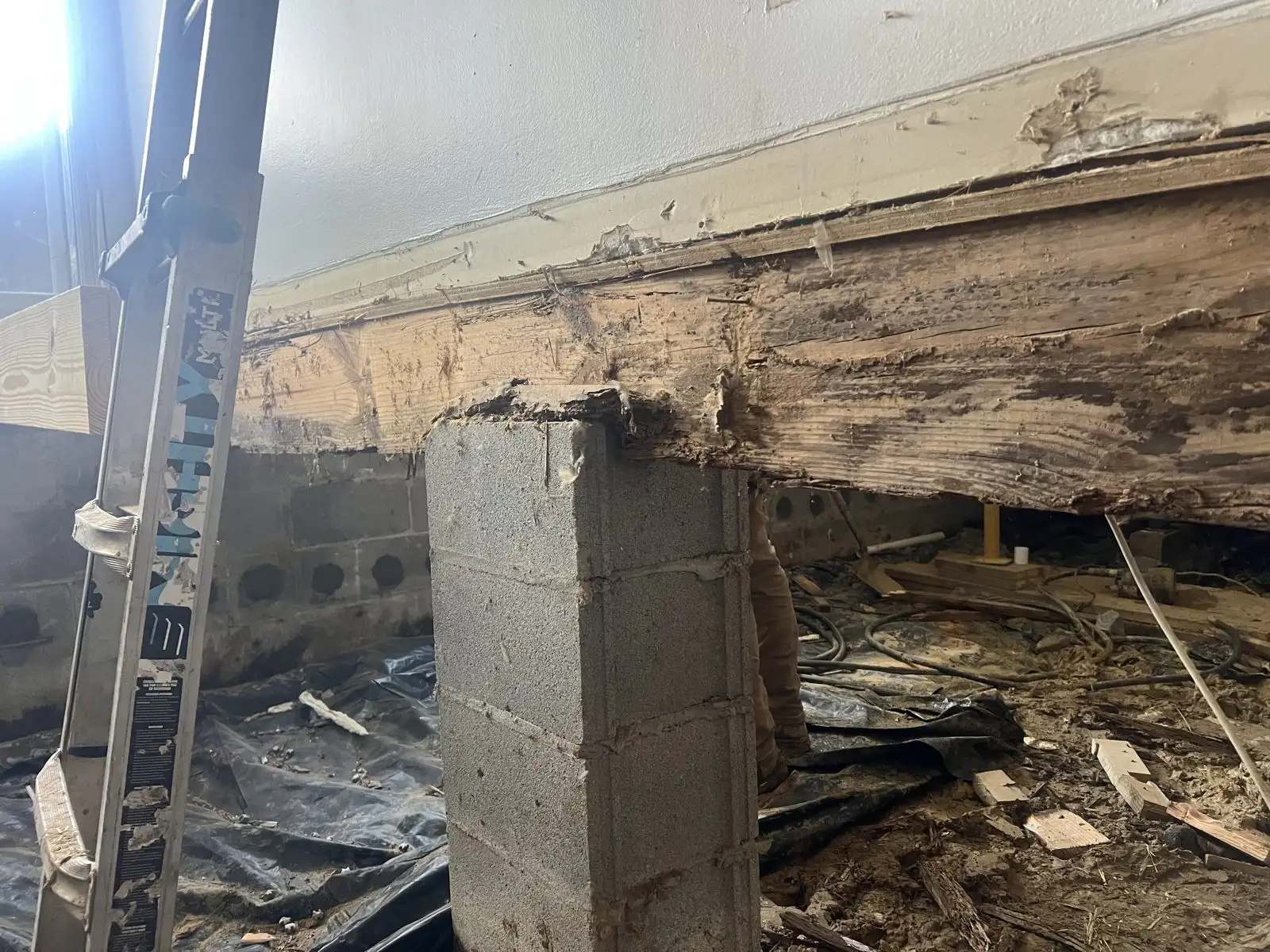
Pest Damaged Framing: Why a Licensed Exterminator Goes In Before We Do
Repairing termite or pest-damaged framing without treating the active infestation first means the new wood is at immediate risk. Ground Up coordinates the right sequence.
On cost: Pest treatment costs are set by the licensed pest control company and vary by method and infestation extent. Liquid termiticide treatment for an average home typically ranges from $800 to $2,000. Ground Up's structural repair work following pest treatment is priced separately based on the framing damage scope.
Overview
Repairing Pest Damaged Framing
Pest treatment in the context of crawl space framing repair refers to the coordinated process of working with licensed pest control professionals to eliminate active wood-destroying insect infestations before structural framing repairs are performed. Ground Up Foundation Repair does not apply pesticides, which requires a separate Tennessee pest control license. Instead, we work directly with trusted pest control partners to ensure that active termite colonies, carpenter ant infestations, or wood-boring beetle populations are addressed before we install new or sistered framing members. This sequencing protects the investment in structural repair and ensures that replacement lumber is not immediately exposed to the same pest pressure that damaged the original framing.
When Ground Up identifies evidence of active or recent pest infestation during a crawl space framing inspection, we document the findings and coordinate a referral to a licensed pest control professional. After pest treatment is complete and the infestation is confirmed to be resolved, Ground Up returns to perform the structural framing repairs. In some cases, additional preventive treatments such as borate application to new framing are incorporated into the structural repair scope to provide a chemical barrier within the wood itself.
Wondering if this is the right fix for what you are seeing? Learn more about the warning signs: Pest Damage to Wood Framing and Visible Wood Rot in Crawl Space . Or browse the full Problem Signs library for framing repair.
Installation Process
How we install repairing pest damaged framing
Pest Evidence Identification During Framing Inspection
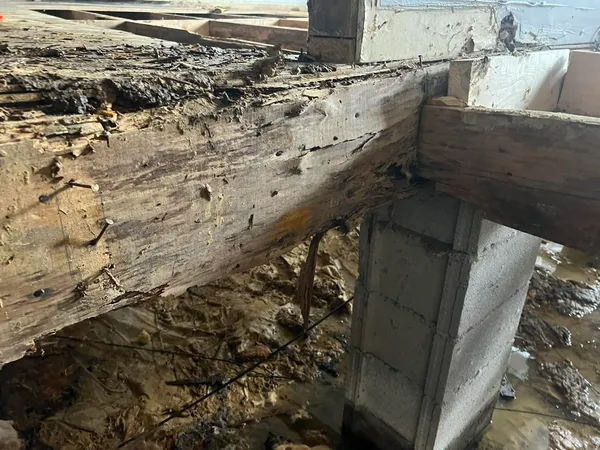
During the initial crawl space inspection, Ground Up technicians document evidence of wood-destroying insects, including mud tubes from subterranean termites, frass from wood-boring beetles or carpenter ants, hollow-sounding or visually damaged wood, and any other signs of active or recent infestation. This documentation is shared with the pest control partner.
Licensed Pest Control Partner Engagement
Ground Up coordinates with a licensed Tennessee pest control professional to perform a dedicated termite or pest inspection. The pest inspector assesses the full extent and species of infestation and recommends the appropriate treatment method, which may include liquid termiticide soil treatment, bait station installation, fumigation, or a combination of methods.
Active Pest Treatment by Licensed Pest Control
The licensed pest control company performs the recommended treatment and provides documentation of the completed service. Treatment timelines vary by method. Liquid soil treatments take effect quickly while bait systems may require multiple service visits over weeks before the colony is confirmed eliminated. Ground Up holds the structural repair scope until treatment is confirmed complete.
Borate Treatment of Existing and New Framing
Once the active pest infestation is addressed, Ground Up applies a borate-based wood preservative to existing framing members in the crawl space and to all new or sistered lumber being installed. Borate penetrates into the wood and provides long-term resistance to both wood-destroying insects and wood rot fungi without the hazards of older pesticide chemistry.
Structural Framing Repairs
With the pest threat addressed and new framing treated, Ground Up performs all structural framing repairs including joist sistering, joist replacement, or beam replacement as identified in the original assessment. This sequencing ensures that new structural members are not installed into a still-active pest environment.
Moisture Control to Reduce Future Pest Pressure
Most wood-destroying insects in Middle Tennessee prefer moist, humid crawl spaces. As part of the overall repair project, Ground Up recommends and can install vapor barriers, dehumidification, or full encapsulation to make the crawl space environment less hospitable to future pest colonization. A dry crawl space is a significant deterrent to re-infestation.
I have seen homeowners skip the pest treatment step to save money and move faster, and within a year they are calling us back because the new lumber is already being attacked. The sequence matters. Treat first, repair second, prevent moisture third. That is the only approach that holds up over time in a Middle Tennessee crawl space.
Why Ground Up
The difference is in the diagnosis
Get several quotes and you'll see a wide range of prices. The gap isn't luck. It's whether the contractor finds the actual cause and stands behind the work.
- In-house certified crews: we never subcontract your repair
- Optional independent third-party engineer review on larger jobs
- Honest three-tier triage: we tell you what can wait, in writing
- Family owned from the same Shelbyville Highway address since 2009
FAQ
Repairing Pest Damaged Framing questions
No. Applying pesticides and termiticides requires a separate Tennessee pest control license that is distinct from a contractor's license. Ground Up's role is structural framing repair. We identify pest evidence during our inspections, coordinate referrals to trusted licensed pest control partners, and apply borate-based wood preservative to framing as part of the structural repair scope.
Installing new structural lumber into a crawl space with an active termite colony or carpenter ant infestation means the new wood is immediately at risk. Termites can begin working on new lumber within weeks of it being installed. Completing pest treatment first and then installing borate-treated replacement framing gives the repair the best chance of long-term success.
For liquid termiticide treatments, which work quickly to create a treated soil zone around the foundation, framing repair can often begin within a week or two after treatment. For bait station programs, which eliminate colonies over a longer period, we coordinate with the pest control provider to confirm colony activity has declined before proceeding. The pest control professional advises on treatment completion timelines.
Borate is a naturally occurring mineral compound that is absorbed into wood and provides long-lasting resistance to termites, carpenter ants, wood-boring beetles, and wood rot fungi. When applied to new framing as a liquid, it penetrates the wood and remains active for the life of the treated member as long as the wood does not become excessively wet. It is one of the most effective preventive treatments for crawl space framing.
Yes, absolutely. Annual termite inspections are strongly recommended for all Middle Tennessee homeowners, especially after a prior infestation. Ground Up consistently recommends ongoing pest monitoring through a licensed pest control company as part of a comprehensive crawl space maintenance plan. Annual inspections allow early detection of new activity before structural damage can recur.
More Solutions
Other solutions we offer
Beam Repair
Structural beams throughout a crawl space home serve distinct load-carrying roles, the sill plate transfers floor loads to the foundation wall, rim joists close off the floor system at the perimeter, and secondary beams support floor joists between the main carrier and the foundation. When any of these members is damaged by rot, insect activity, or physical stress, the floor system above loses support. Ground Up Foundation Repair identifies the affected beam, determines the appropriate repair method, and restores full structural capacity without disrupting the living space above.
Structural Beam Replacement
The main girder beams and support beams in a crawl space are the primary load-bearing members of the floor system. They span between foundation walls and piers, carrying the floor joists that in turn support the subfloor and everything above. When these beams are compromised by moisture-driven rot, pest infestation, or overloading, the consequences extend throughout the floor system above. Structural beam replacement is the appropriate solution when beams have degraded beyond the point where repair or reinforcement is sufficient. Ground Up Foundation Repair provides beam replacement in crawl spaces throughout Middle Tennessee, using properly sized dimensional lumber or engineered lumber products to restore full structural capacity.
Carrier Beam Repair
The carrier beam, also called the main girder, is the primary horizontal member that supports your floor joists and transfers their load to posts and the foundation. When a carrier beam cracks, sags, or rots, every joist it carries becomes compromised, causing widespread floor movement across an entire section of your home. Ground Up Foundation Repair assesses carrier beam damage, determines whether repair or replacement is appropriate, and restores full load capacity with minimal disruption to the living space above.
Crawl Space Jack Installation
Crawl space support jacks are adjustable steel columns installed on concrete footings beneath the floor framing of a crawl space home. They provide permanent supplemental support for floor joists and carrier beams that have deflected beyond what sistering alone can address, for spans that are too long for the existing framing depth, or for homes where the original post spacing was inadequate. Because they are adjustable after installation, crawl space jacks also allow incremental floor leveling without additional structural work. Ground Up Foundation Repair sizes, spaces, and installs support jacks to match the load conditions of each specific home.
Floor Joist Repair Plates
Floor joist repair plates, also called mending plates, joist plates, or structural connector plates, are heavy-gauge galvanized steel plates fastened across a crack, split, or notched section of a floor joist to restore local bending and shear capacity. They are most effective when damage is localized to a specific point along an otherwise sound joist, rather than distributed along its length. Repair plates are a faster and lower-cost solution than sistering in specific circumstances, and they are frequently used in combination with sistering when a joist has both a discrete crack point and overall reduced stiffness. Ground Up evaluates each joist individually and recommends the repair method, plates, sistering, or full replacement, that matches the actual damage pattern.
Floor Joist Repair
Floor joists are the horizontal structural members that span from beam to beam beneath your subfloor, carrying the weight of everything in your home. When they are damaged by moisture, rot, or pests, they lose load-bearing capacity and the floors above begin to flex, bounce, or sag. Floor joist repair restores the structural capacity of compromised framing through sistering, partial replacement, or full joist replacement, depending on the extent and nature of the damage. Ground Up Foundation Repair specializes in crawl space framing repair across Middle Tennessee, where humid conditions make joist damage an especially common problem.
Found a problem? Get a straight answer
Free inspection, written estimate, honest triage. No pressure.